
Introduction
Miter saw components play a critical role in the performance, accuracy, and safety of this essential woodworking tool. From the blade and motor to the fence and adjustment controls, each part is designed to work together to deliver precise cuts. Understanding how these components function helps users operate the saw efficiently, maintain it properly, and achieve professional-quality results.
Table of Contents
What is a Miter Saw?
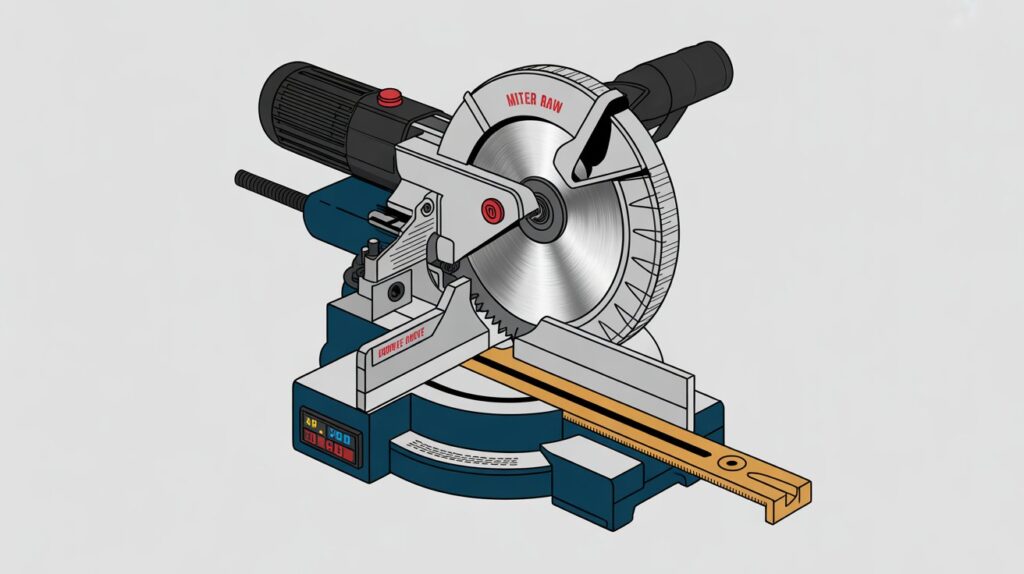
A miter saw is a specialized woodworking tool designed to make accurate crosscuts and angled cuts on wood, plastic, or similar materials. It consists of several key miter saw parts, including the blade, motor, fence, and table, which work together to provide precision and stability during cutting.
This power tool is ideal for projects that require exact angles, such as framing, molding, and furniture making. Many models include compound miter saw components that allow for bevel cuts, while sliding miter saw parts provide extended reach for wider boards. Features like the dust collection system and safety features ensure a clean and secure working environment.
By understanding its design and function, users can achieve higher cutting accuracy and maintain their tool effectively, ensuring it performs reliably for years. Proper alignment and regular tool calibration further enhance its performance and longevity.
Importance of Knowing Miter Saw Components
Understanding the different miter saw parts is essential for anyone working with this tool. Knowing how the blade, motor, fence, and bevel adjustment work together allows users to make precise and safe cuts. Proper knowledge of these parts also helps in tool calibration and maintaining cutting accuracy, which is critical for professional-quality woodworking.
Familiarity with the dust collection system and other safety features ensures a cleaner and safer workspace, reducing the risk of accidents. Additionally, knowing how to care for each component improves the overall performance and longevity of the saw, making it more cost-effective in the long run. Regular maintenance of the table, sliding miter saw parts, and compound miter saw components prevents wear and tear, ensuring smooth operation over time.
By mastering these elements, woodworkers can complete projects efficiently, achieve consistent results, and protect both themselves and their equipment.
Detailed List of Miter Saw Components
Understanding individual miter saw parts helps users improve accuracy, safety, and maintenance. Below is a detailed breakdown of 40 essential components found in most models, including compound miter saw components and sliding miter saw parts.
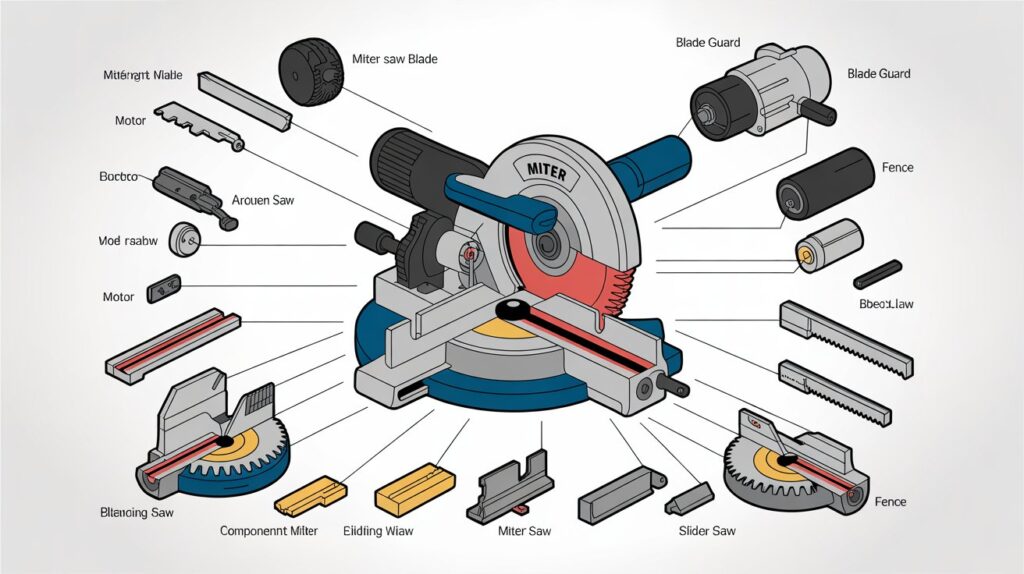
Mounting holes – Secure the saw to a workbench for stability.
Miter saw blade – The cutting element responsible for clean and precise cuts.
Motor – Powers the blade and determines cutting strength.
Blade guard – A critical safety feature that covers the blade when not in use.
Fence – Keeps the workpiece aligned for straight cuts.
Table – Provides a stable surface and supports rotation for angled cuts.
Base – The foundation that supports the entire tool.
Miter scale – Displays angle measurements for accuracy.
Bevel scale – Helps set vertical cutting angles using miter saw bevel adjustment.
Miter lock handle – Secures the desired angle during cutting.
Bevel lock lever – Holds the bevel angle in place.
Handle – Allows controlled operation of the saw.
Trigger switch – Activates the power saw components safely.
Electric brake – Stops the blade quickly after releasing the trigger.
Dust collection system – Reduces debris and improves workshop safety.
Dust port – Connects to a vacuum or dust bag.
Arbor – Holds the blade securely in place.
Arbor nut – Locks the blade onto the arbor.
Spindle lock – Prevents blade rotation during blade replacement guide procedures.
Slide rails – Enable forward and backward motion on sliding miter saw parts.
Rail lock – Secures the sliding mechanism when not in use.
Depth stop – Controls cutting depth for repetitive tasks.
Angle cutting saw indicator – Shows exact cutting position.
Laser guide – Enhances cutting accuracy by marking the cut line.
LED work light – Improves visibility during operation.
Extension wings – Support longer materials.
Work clamp – Holds material firmly in place.
Pivot arm – Allows vertical movement of the blade.
Bearing assembly – Ensures smooth blade rotation.
Gear housing – Protects internal drive components.
Carbon brushes – Transfer power to the motor.
Cooling vents – Prevent overheating during extended use.
Cord strain relief – Protects the power cord from damage.
Power cord – Supplies electricity to the tool.
On/off safety lock – Prevents accidental startup.
Rear fence support – Adds stability for larger cuts.
Tool calibration adjustment screws – Maintain proper alignment.
Saw alignment guide – Assists in precise setup.
Cut line indicator – Helps position materials accurately.
Table insert – Reduces tear-out around the blade.
How Each Component Works Together
All miter saw parts are designed to function as a coordinated system to deliver accurate and controlled cuts. The motor powers the miter saw blade, while the table and fence hold the material steady to maintain proper alignment. This combination ensures consistent cutting accuracy during every operation.
The miter saw bevel adjustment and angle controls allow the angle cutting saw to perform precise miter and bevel cuts. On advanced models, sliding miter saw parts work with guide rails to extend the cutting range without sacrificing stability. These elements rely on proper tool calibration and saw alignment to function smoothly.
Supporting systems such as the dust collection system and built-in safety features improve workshop safety and visibility. When all compound miter saw components are properly aligned and maintained, the tool operates efficiently, delivers clean results, and reduces user fatigue. This seamless interaction between components is what makes the tool reliable for both basic and professional woodworking tools applications.
Common Issues and Maintenance Tips
Over time, wear and tear can affect essential miter saw parts, leading to reduced performance and safety risks. A dull or damaged miter saw blade is one of the most common issues and can cause rough cuts or material burning. Regular inspection and timely replacement using a proper blade replacement guide help maintain clean results and protect the motor from strain.
Misalignment of the fence or table often reduces cutting accuracy and should be corrected through routine tool calibration and saw alignment. Problems with sliding miter saw parts, such as stiff rails, can limit movement and should be cleaned and lubricated to ensure smooth operation.
Clogged or poorly maintained dust collection system components can reduce visibility and compromise workshop safety. Keeping vents clear and checking compound miter saw components for loose fasteners improves efficiency and extends tool life. Consistent maintenance ensures reliable performance and prevents costly repairs over time.
Tips for Choosing a Miter Saw
When selecting a miter saw, start by evaluating the quality of its miter saw parts, as durable components ensure long-term reliability. A powerful motor paired with a high-quality miter saw blade delivers smoother cuts and better cutting accuracy, especially for demanding woodworking tasks.
Consider models with adjustable miter saw bevel adjustment and sturdy compound miter saw components if your projects require angled or bevel cuts. For wider materials, look for efficient sliding miter saw parts that provide extended reach without sacrificing stability. A solid fence and well-designed table are also essential for proper saw alignment.
Built-in safety features and an effective dust collection system improve workshop safety and create a cleaner work environment. Finally, prioritize easy tool calibration and maintenance, as well-calibrated woodworking tools deliver consistent performance and professional-quality results.
Conclusion
Understanding miter saw components is essential for achieving accurate cuts, maintaining safety, and extending the life of the tool. Each part, whether responsible for power, alignment, or control, contributes to smooth and reliable operation. By learning how these components work together and maintaining them properly, users can avoid common issues and improve overall performance. A well-maintained miter saw not only delivers consistent results but also supports safer and more efficient woodworking projects.
Frequently Asked Questions About Miter Saw Components
What are the main miter saw components?
The main miter saw components include the blade, motor, fence, table, base, handle, and adjustment controls. These parts work together to provide accurate, controlled, and safe cutting for woodworking tasks.
Which miter saw components affect cutting accuracy the most?
The blade, fence, table alignment, and adjustment mechanisms have the greatest impact on accuracy. Proper calibration and maintenance of these components ensure clean and precise cuts.
How often should miter saw components be maintained?
Basic maintenance should be performed regularly, including cleaning dust buildup, checking alignment, and inspecting moving parts. Blades and wear-prone components should be checked before major projects.
Can worn miter saw components cause safety issues?
Yes, damaged or worn components can increase the risk of kickback, inaccurate cuts, or motor strain. Regular inspection helps maintain safe operation and prevents accidents.
Are miter saw components the same for all models?
Most models share similar core components, but sliding and compound versions may include additional parts. Design and layout can vary depending on the manufacturer and saw type.
When should miter saw components be replaced?
Components should be replaced when they show signs of excessive wear, damage, or reduced performance. Blades, brushes, and alignment parts are commonly replaced over time.