
Introduction
Cutting large sheets of plywood, MDF, and laminate requires accurate measurements, stable material support, and suitable equipment. The right panel saw accessories can help woodworkers achieve consistent cuts, handle heavy panels more easily, control sawdust, and maintain a safer working environment.
From guide rails and measuring systems to clamps, support tables, and dust collection equipment, different accessories help with specific woodworking tasks. In this guide, you will learn about the main types, their uses, safety considerations, and how to choose, install, and maintain suitable accessories for your panel saw.
Table of Contents
What Are Panel Saw Accessories?
Panel saw accessories are additional tools, attachments, and support devices used with a panel saw to improve its performance, accuracy, and ease of operation. They help woodworkers handle large sheets of material, make consistent cuts, control sawdust, and maintain a more organized workspace. These accessories are useful in woodworking shops, furniture factories, cabinet-making businesses, and other places where sheet materials are cut regularly.
Unlike the main machine components, such as the motor, cutting unit, and frame, accessories provide extra support for specific tasks. The type of accessory needed depends on the panel saw design, the material being cut, and the operator’s working requirements.
For example, guide rails and measuring systems help position panels and maintain straight cutting lines. Clamps and hold-down devices help secure compatible workpieces, while extension tables and support rollers make it easier to handle large or heavy sheets. Dust collection equipment removes sawdust from the cutting area, helping keep the workspace cleaner.
Some accessories also support maintenance and safe operation. Blade guards and other manufacturer-approved safety devices help protect operators from certain hazards when correctly installed and used. However, accessories must always be compatible with the machine and should never replace proper training or safe operating procedures.
Common Types of Panel Saw Accessories
The following table explains several common accessories and their main purposes.
| Accessory | Main purpose |
|---|---|
| Guide rails and cutting guides | Help guide the cutting movement along the intended path. |
| Measuring systems and stops | Help position panels and repeat measurements accurately. |
| Clamps and hold-down devices | Secure compatible materials during cutting. |
| Extension tables and support surfaces | Provide additional support for large panels. |
| Rollers and material supports | Help move heavy sheets more easily. |
| Dust collection equipment | Collects sawdust and wood particles from the cutting area. |
| Blade guards and safety devices | Help reduce exposure to cutting hazards when used correctly. |
| Replacement blades and compatible blade accessories | Support different cutting requirements, depending on the machine. |
Not every panel saw uses the same accessories. Vertical panel saws often use vertical supports and material-positioning systems, while horizontal panel saws may use different tables, stops, and automated handling equipment. Always check the manufacturer’s instructions before purchasing or installing an attachment.
Understanding the purpose of each accessory helps you select equipment that suits your workshop, materials, and cutting needs. The goal is to improve accuracy, simplify material handling, and maintain a safer, more efficient working environment without adding unnecessary equipment.
Why Are Accessories Important for Panel Saws?
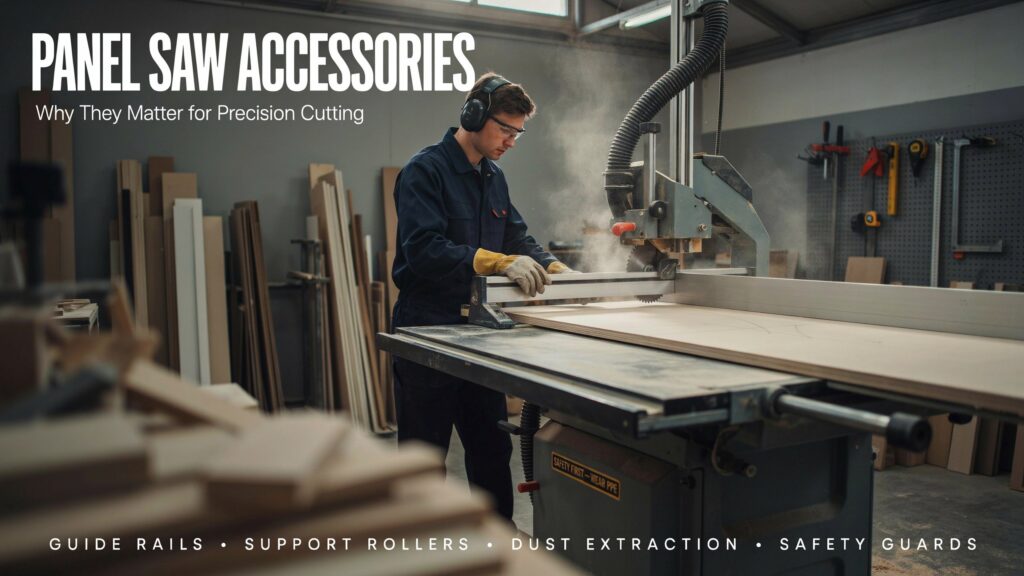
Accessories play an important role in improving how a panel saw performs during everyday woodworking tasks. The right equipment helps operators position materials correctly, handle large sheets more easily, maintain consistent measurements, and manage sawdust. Choosing suitable accessories can also help reduce common cutting problems and support safer working practices.
The accessories you need depend on your machine type, workshop space, and the materials you cut. Here are the main reasons these additional tools are useful.
Improve Cutting Accuracy
Accurate cuts are important when working with plywood, MDF, laminate, and other sheet materials. Measuring systems, cutting guides, and adjustable stops help operators position panels correctly and repeat measurements across multiple cuts.
Properly aligned guides and fences can help maintain straight cutting lines. However, the final result also depends on blade condition, machine setup, material quality, and correct operating techniques.
Provide Better Material Support
Large wood panels can be difficult to handle because they are heavy, wide, and sometimes awkward to position. Extension tables, support rollers, and suitable workpiece supports help keep materials stable during handling and cutting.
Proper support is especially important when cutting full sheets of plywood or MDF. It can help prevent unwanted movement and reduce the chance of damaging the material. Always arrange supports according to the saw manufacturer’s instructions.
Make Material Handling Easier
Moving large sheets repeatedly can take considerable time and effort. Material handling rollers, panel supports, and suitable positioning systems help operators move materials into place more smoothly.
These accessories can be particularly useful in furniture workshops and cabinet-making businesses where workers cut multiple panels each day. The correct setup can improve workflow and reduce unnecessary lifting, although heavy materials may still require suitable lifting equipment or assistance.
Help Control Sawdust
Cutting wood-based materials produces sawdust and fine particles that can collect around the machine and spread through the workshop. A compatible dust collection system helps capture particles near the cutting area and keeps the workspace cleaner.
Effective dust extraction is especially important when cutting MDF and other materials that produce fine dust. Select a system suitable for the machine and material, and follow appropriate workplace dust-control and respiratory protection guidance.
Support Safer Operation
Safety-related accessories can help reduce certain risks when they are correctly selected, installed, and maintained. Depending on the machine, these may include blade guards, suitable workpiece clamps, and manufacturer-approved protective devices.
However, accessories cannot eliminate every hazard. Operators should follow the machine manual, use required personal protective equipment, keep guards in place, and never bypass safety mechanisms.
Reduce Cutting Errors and Material Waste
Incorrect measurements, unstable panels, and poorly adjusted guides can lead to inaccurate cuts. Measuring systems, stops, and support devices help operators prepare materials more carefully and repeat dimensions consistently.
Better preparation may reduce mistakes and unnecessary material waste. However, results still depend on accurate measurements, proper blade selection, machine condition, and operator skill.
Improve Workshop Efficiency
An orderly workspace helps workers handle recurring cutting jobs more smoothly. The right accessories simplify panel measuring, positioning, supporting, and handling while reducing the need for frequent adjustments.
For example, a cabinet maker who cuts several panels to the same width may benefit from a properly adjusted stop system. A workshop handling large sheets may gain more from additional material supports and suitable dust extraction.
The best setup depends on the actual work being performed rather than the number of accessories installed.
Summary of the Main Benefits
| Benefit | How accessories help |
|---|---|
| Cutting accuracy | Measuring systems and guides help maintain consistent dimensions. |
| Material support | Tables and rollers support large or heavy panels. |
| Easier handling | Positioning equipment helps move materials into place. |
| Dust control | Extraction systems collect airborne and loose sawdust. |
| Safer operation | Compatible guards and protective devices help reduce certain hazards. |
| Less material waste | Accurate setup helps prevent avoidable cutting errors. |
| Better workflow | Suitable accessories make repeated tasks easier to organize. |
Overall, accessories help operators adapt a panel saw to their particular woodworking needs. Before choosing any equipment, check machine compatibility, the size and weight of the materials, the type of cuts required, and the manufacturer’s safety instructions. Selecting suitable accessories is more useful than purchasing equipment that does not support your actual work.
Essential Accessories Used With Panel Saws
Choosing suitable accessories can make panel cutting easier, improve measurement consistency, and help operators handle large sheets of wood-based materials. Different accessories perform different tasks, from guiding the cutting movement to supporting panels and collecting sawdust. The best setup depends on the machine design, the material being cut, and the type of work performed in the workshop.
The following are common accessories used with panel saws in woodworking, furniture production, and cabinet making.
Guide Rails and Cutting Guides
Guide rails and cutting guides help direct the cutting movement along the intended path. They are particularly useful when straight, consistent cuts are required.
Depending on the panel saw design, the guide system may be built into the machine or supplied as a compatible attachment. A properly adjusted guide helps the operator maintain the intended cutting line and can reduce alignment errors.
Before using a guide rail, check that it is securely installed, correctly aligned, and suitable for the specific machine. A damaged or incorrectly adjusted guide can affect cutting accuracy.
Stops, Fences, and Measuring Systems
Stops, fences, and measurement tools help users align panels correctly before making a cut. They are particularly helpful when producing multiple pieces with matching measurements.
A measuring scale helps establish the required distance, while an adjustable stop can provide a repeatable reference point. A suitable fence supports consistent positioning and helps guide the material according to the machine’s design.
These systems are valuable for cabinet makers who regularly prepare shelves, doors, side panels, and other components. However, accurate results still depend on correct measurements, proper setup, and regular alignment checks.
Clamps and Hold-Down Devices
Clamps and hold-down devices help secure compatible workpieces during cutting. They reduce unwanted movement and can make material positioning more stable.
Different panel saws use different clamping arrangements. Some machines have integrated clamping systems, while others accept specific attachments designed by the manufacturer.
Always use clamps according to the machine manual. Never position a clamp where it could interfere with the blade, cutting carriage, or other moving parts.
Extension Tables and Workpiece Supports
Extension tables and workpiece supports provide additional surface area for handling large sheets. They are useful when the standard table or support frame does not provide enough space for the material being processed.
Stable support helps prevent panels from tipping, bending, or moving unexpectedly during handling. It can also make it easier to position plywood, MDF, and laminate sheets before cutting.
Choose supports that match the machine’s design and the size and weight of the workpieces. Poorly positioned supports can interfere with machine movement or create an unstable setup.
Rollers and Material Handling Supports
Rollers and material handling supports help move large panels into position with less effort. They are particularly useful in workshops that process full sheets of plywood, MDF, particleboard, and similar materials.
Depending on the machine, rollers may be installed as part of a feeding system or used with compatible support equipment. They can improve material movement and reduce the need to lift or drag panels across surfaces.
Inspect rollers regularly to ensure they turn freely and remain securely mounted. Keep hands clear of pinch points, and use appropriate lifting equipment or assistance when panels are too heavy to handle safely.
Dust Collection and Extraction Equipment
Dust collection equipment captures sawdust and fine particles produced during cutting. A suitable extraction system helps keep the cutting area cleaner and reduces the spread of dust throughout the workshop.
Some panel saws connect directly to a central dust extraction system, while others use compatible dust collection units. The required capacity depends on the machine, the material, and the extraction design.
Regularly inspect hoses, connections, filters, and collection containers. A blocked or poorly connected system may collect dust less effectively. Because fine wood dust can pose health and fire risks, follow appropriate dust-control procedures and the equipment manufacturer’s guidance.
Blade Guards and Safety Devices
Blade guards and other manufacturer-approved safety devices help protect operators from certain hazards associated with cutting equipment. Their design varies according to the type of panel saw and its cutting mechanism.
A guard may help prevent accidental contact with the blade or limit exposure to the cutting area. Other safety devices may help control access to hazardous moving parts.
Never remove or bypass a required guard to make a cut easier. Inspect safety components regularly and replace damaged parts with compatible components approved for the machine. Safe operating procedures and proper training remain essential even when safety accessories are installed.
Saw Blades and Compatible Blade Accessories
The saw blade has a direct effect on the quality and suitability of a cut. Different blades are designed for different materials, thicknesses, and cutting requirements.
For example, a suitable blade for plywood may differ from one designed for laminate or other manufactured boards. Tooth design, blade diameter, arbor size, and machine speed requirements must all be considered when selecting a replacement.
Some machines also use specific blade-related components or adjustment accessories. Always check the manufacturer’s specifications before purchasing a blade or related part. Using an incompatible blade can damage the machine, produce poor cuts, or create a serious safety risk.
How to Choose Between Different Accessories
Not every workshop needs every type of attachment. A small woodworking shop may benefit most from accurate measuring guides, reliable material support, and effective dust extraction. A busy furniture workshop may also need repeatable stop systems and suitable material handling equipment.
When selecting panel saw accessories, consider these factors:
- Machine compatibility: Confirm that the accessory is designed for your particular panel saw.
- Material type: Consider whether you mainly cut plywood, MDF, laminate, or other sheet materials.
- Panel size and weight: Choose support equipment that can handle the workpieces safely.
- Cutting requirements: Match measuring systems and guides to the accuracy your work requires.
- Maintenance needs: Select equipment that can be inspected, cleaned, and maintained properly.
Choosing suitable accessories can make cutting tasks more organized and productive. Prioritize tools that improve accuracy, address specific workshop needs, and are safe to use with your machine instead of purchasing attachments you seldom need.
Accessories for Vertical and Horizontal Panel Saws
Panel saws are commonly available in vertical and horizontal designs. Both types are used to cut sheet materials such as plywood, medium-density fiberboard (MDF), particleboard, and laminate. However, their structures and material-handling methods differ, so the accessories needed for each machine may also vary.
Choosing suitable panel saw accessories helps operators support materials, maintain accurate measurements, manage dust, and work more efficiently. Before selecting any attachment, it is important to understand how the machine operates and which accessories are compatible with its design.
Accessories Commonly Used With Vertical Panel Saws
A vertical panel saw holds large sheets in an upright position. The operator typically positions the material against a support frame while the cutting unit moves along a guide system. This design can save floor space and is useful in woodworking shops, sign-making businesses, and cabinet-making workshops.
Vertical panel saws often use the following types of accessories.
Vertical material support system
A support frame holds the panel in position during cutting. Depending on the machine design, additional supports may help accommodate different panel sizes and reduce unwanted movement.
Guide rails and cutting guides
Guide rails direct the cutting unit along its intended path. Proper alignment helps produce straight cuts and maintain consistent dimensions.
Measuring scales and cutting stops
Measuring scales and stops help operators position materials accurately. They are particularly useful when several panels need to be cut to the same width or length.
Panel rollers and support rollers
Rollers can help move heavy sheets into position before cutting. Their usefulness depends on the machine’s support arrangement and the size of the material being handled.
Dust extraction equipment
Dust collection systems help capture sawdust generated during cutting. A compatible extraction setup is important for maintaining a cleaner workspace and controlling exposure to airborne wood particles.
Safety guards and protective devices
Machine-approved guards and other safety devices help reduce exposure to cutting hazards. Their installation and use should follow the manufacturer’s instructions.
Accessories Commonly Used With Horizontal Panel Saws
A horizontal panel saw supports sheet materials on a table, and its cutting unit moves through the material according to the machine’s design. These machines are commonly used in furniture manufacturing, cabinet production, and workshops that process large quantities of sheet goods.
Horizontal panel saws may use the following accessories.
Extension tables and panel supports
Additional table surfaces support large sheets and help operators position materials before cutting. Supports must be stable and suitable for the weight of the workpiece.
Side fences and measuring systems
Fences provide a reference for positioning panels, while measuring systems help operators establish the required dimensions. Correct adjustment is important when producing repeated cuts.
Programmable positioning systems
Some advanced horizontal panel saws use electronic controls or computer-controlled positioning systems. These features can help automate measurements and repeated cutting operations. Availability depends on the machine model and configuration.
Clamping systems
Compatible clamps hold material in position during cutting. Depending on the machine, clamping may be manual, pneumatic, or integrated into an automated system.
Material handling equipment
Rollers, loading supports, and other handling equipment can help move large panels onto the machine. Larger production facilities may also use mechanical lifting or automated feeding systems.
Dust extraction systems
Horizontal panel saws can produce substantial amounts of sawdust during repeated cutting. Properly sized extraction equipment helps capture particles from the cutting area and supports effective workshop dust control.
Blade-related components and safety devices
Replacement blades and compatible blade-related components must match the machine specifications. Required guards and other protective devices should remain correctly installed and functional.
How to Choose Accessories for Your Machine Type
The best accessories depend on how the panel saw is designed, the materials being cut, and the work performed in the workshop. An attachment made for one machine may not fit or function correctly on another.
Consider the following points before choosing accessories:
- Check the machine model: Review the manufacturer’s manual to identify compatible attachments and replacement parts.
- Consider the material: Plywood, MDF, laminate, and other sheet materials may require different blade specifications and handling arrangements.
- Evaluate panel dimensions: Large or heavy sheets may need additional support equipment or mechanical handling assistance.
- Identify accuracy requirements: Measuring systems, fences, and stops can help when cutting repeated parts to consistent dimensions.
- Review dust control needs: Choose extraction equipment suitable for the machine and the materials being processed.
- Prioritize safety: Make sure guards, clamps, and other protective devices are approved for the specific saw and do not interfere with its operation.
Vertical vs. Horizontal Panel Saw Accessories
| Feature | Vertical panel saw | Horizontal panel saw |
|---|---|---|
| Material position | Upright against a support frame | Flat on a table or support surface |
| Common support equipment | Vertical supports and panel positioning systems | Tables, extension supports, and loading systems |
| Measuring equipment | Guides, scales, and cutting stops | Fences, measuring systems, and positioning controls |
| Material handling | Panel rollers and suitable loading supports | Rollers, loading supports, and optional automated systems |
| Dust control | Compatible extraction near the cutting area | Extraction designed for the machine’s cutting system |
| Typical use | Space-conscious workshops and sheet cutting | Furniture production and higher-volume panel processing |
The accessories listed above are general examples, not a universal equipment list. Specific requirements vary by manufacturer, machine size, and model.
Understanding these differences helps you select equipment that suits your panel saw rather than purchasing unnecessary or incompatible attachments. Always follow the machine manual, inspect accessories regularly, and ensure that material supports and safety devices are correctly installed before operating the saw.
How Panel Saw Accessories Improve Cutting Accuracy
Accurate cutting is essential when preparing plywood, MDF, laminate, and other sheet materials for furniture or cabinet making. Even a small measurement error can cause parts to fit poorly, create uneven edges, or waste valuable material. The right accessories help operators measure, position, and support workpieces correctly before and during cutting.
Suitable panel saw accessories can improve consistency by reducing positioning errors and helping operators repeat measurements. Cutting precision also relies on blade condition, proper machine adjustment, the quality of the material, and the operator’s experience.
Measuring Systems Help Maintain Correct Dimensions
Measuring systems help operators determine where a cut should be made. Depending on the machine, these systems may include measuring scales, digital readouts, or electronic positioning controls.
Accurate measurements are particularly important when cutting several pieces to the same size. For example, a cabinet maker preparing multiple shelves needs consistent widths so the finished parts fit properly.
Verify the measuring system using a trusted reference and double-check the dimensions before starting a cut. Incorrect calibration can lead to repeated measurement mistakes.
Guide Rails Help Produce Straight Cuts
Guide rails and cutting guides help direct the cutting unit along a defined path. When properly aligned, they support straight and consistent cuts across sheet materials.
A guide that is loose, damaged, or incorrectly adjusted may cause the cutting unit to move away from the intended line. Inspect the guide system regularly and follow the manufacturer’s instructions when making adjustments.
Fences and Stops Support Repeatable Cuts
Fences and cutting stops provide reference points for positioning materials. They are useful when a project requires several panels with matching dimensions.
For example, when producing multiple cabinet side panels, a correctly adjusted stop can help the operator position each workpiece consistently. This reduces the need to measure every piece from the beginning.
However, stops must be set correctly, and measurements should be checked before starting a production run.
Clamps Help Keep Materials Stable
Clamps and approved hold-down devices help prevent compatible workpieces from shifting during cutting. Unwanted movement can affect the cutting line and damage the material.
Proper clamping is especially useful when handling panels that are difficult to position securely. Always use the clamping system designed for the specific machine and ensure that it does not interfere with the blade or moving components.
Support Tables Help Prevent Panel Movement
Large sheets can be difficult to control because of their size and weight. Extension tables and suitable workpiece supports help keep materials stable during positioning and cutting.
Adequate support helps prevent panels from shifting, tipping, or flexing during cutting. This is especially useful when working with large plywood, MDF, and other sheet materials that need a straight, steady cut.
Supports should be level, stable, and positioned according to the machine manufacturer’s instructions.
Correct Blade Selection Improves Cut Quality
The saw blade has a direct effect on the finish and accuracy of a cut. Different materials may require different blade designs, tooth configurations, and cutting specifications.
For example, a suitable blade for laminate may differ from one intended for general plywood cutting. Using the wrong blade can cause rough edges, chipping, or excessive cutting resistance.
Before replacing a blade, check its diameter, arbor size, speed rating, and material suitability against the machine specifications. A sharp, properly installed blade helps produce cleaner results when the machine is correctly adjusted.
Regular Alignment Checks Reduce Cutting Errors
Even good accessories cannot maintain accuracy if they are poorly adjusted or worn. Guide rails, fences, measuring systems, and other positioning components should be inspected according to the manufacturer’s maintenance schedule.
Regular checks can help identify loose fittings, inaccurate measurements, worn rollers, or damaged support surfaces before they affect the finished work.
Practical Ways to Improve Panel Cutting Accuracy
| Accessory or component | How it supports accuracy |
|---|---|
| Measuring scales and digital readouts | Help establish the required cutting dimensions. |
| Guide rails | Help guide the cutting movement along the intended path. |
| Fences and stops | Support consistent positioning for repeated cuts. |
| Clamps and hold-down devices | Help prevent unwanted movement of compatible workpieces. |
| Extension tables and supports | Keep large panels stable during handling. |
| Suitable saw blades | Help produce clean cuts in the intended material. |
| Alignment and calibration tools | Help verify that measuring and guiding systems are correctly adjusted. |
Common Mistakes That Affect Cutting Accuracy
Avoid relying on damaged measuring scales, using poorly aligned fences, or cutting large sheets without adequate support. Do not assume that every repeated cut will be accurate simply because the same stop setting is used. Check the setup and verify the first cut before continuing with multiple pieces.
It is also important to avoid forcing material through the cutting area or making adjustments while the machine is running. Follow the manufacturer’s safe operating procedures whenever inspecting or adjusting the equipment.
In summary, accurate panel cutting requires more than a good saw blade. Proper measuring systems, aligned guides, reliable stops, stable material supports, and regular maintenance all contribute to consistent results. Choosing compatible equipment and checking the setup before cutting can help reduce errors, improve finished edges, and limit unnecessary material waste.
Safety Accessories Every Panel Saw Operator Should Understand
Operating a panel saw requires attention, proper training, and suitable safety equipment. Although these machines help woodworkers cut large sheets of material efficiently, the exposed blade, moving parts, and flying wood particles can create serious hazards. Using the correct safety accessories and following the manufacturer’s instructions can help reduce these risks.
Suitable safety equipment should match the machine design, the material being cut, and the working environment. Before using any accessory, check that it is compatible with the saw and does not interfere with normal operation.
Blade Guards and Protective Covers
Blade guards help reduce the risk of accidental contact with dangerous cutting components. Their design varies between vertical and horizontal panel saws, depending on how the blade and cutting unit operate.
Some machines use fixed guards, while others have movable or integrated protective covers. These devices should remain correctly installed and functional according to the manufacturer’s instructions.
Never remove or bypass a required blade guard to make a cut easier. If a guard is damaged, loose, or missing, stop using the machine until the problem has been corrected.
Clamps and Hold-Down Devices
Clamps and hold-down devices help secure compatible panels during cutting. By limiting unwanted movement, they can make material positioning more stable and help reduce the risk of the workpiece shifting unexpectedly.
The correct clamping method depends on the panel saw’s design. Some machines have built-in clamping systems, while others accept specific manufacturer-approved attachments.
Always position clamps as instructed and keep them clear of the blade and moving components. Never use an improvised clamping arrangement that could interfere with the cutting operation.
Dust Collection and Extraction Equipment
Cutting plywood, MDF, particleboard, and other wood-based materials can release fine dust into the air. Repeated exposure to wood dust can cause health problems, so effective dust control is an important part of workshop safety.
A suitable dust collection system captures particles near the cutting area and helps prevent dust from spreading throughout the workspace. Depending on the machine, this may involve a dedicated extraction unit or a connection to a central dust collection system.
To maintain effective dust control:
- Inspect extraction hoses and connections regularly.
- Clean or replace filters according to the manufacturer’s instructions.
- Empty collection containers safely and as required.
- Use suitable respiratory protection when the risk assessment or workplace guidance requires it.
Dust extraction does not eliminate every airborne particle. Follow applicable workplace safety guidance and the equipment manufacturer’s recommendations.
Emergency Stops and Machine Safety Controls
Emergency-stop buttons and other built-in safety controls allow operators to stop the machine when a dangerous situation occurs. Their location and operation vary by model.
Operators should know where the emergency stop is located and understand how to use it before starting work. Check that safety controls function correctly according to the manufacturer’s inspection procedures.
Never bypass an interlock or other protective control. If an emergency stop or safety control is damaged or fails to work properly, take the machine out of service until it has been inspected and repaired by a qualified person.
Push Devices and Safe Material Handling Tools
Some woodworking machines use push sticks, push blocks, or similar devices to keep hands away from hazardous cutting areas. However, these tools are not suitable for every panel saw or every cutting operation.
Use push tools only when they are designed for your machine and the job you are performing. Check the user manual and follow approved safety procedures instead of assuming that a table saw accessory is safe for a panel saw.
For large or heavy sheets, suitable panel-handling equipment, lifting aids, or assistance from trained workers may be necessary. Keep hands away from pinch points and avoid lifting loads that cannot be handled safely.
Personal Protective Equipment
Personal protective equipment (PPE) provides an additional layer of protection while operating woodworking machinery. The required equipment depends on the hazards present and the manufacturer’s instructions.
Common examples include:
- Safety glasses: Help protect the eyes from flying particles.
- Hearing protection: Helps reduce exposure to harmful machine noise.
- Suitable respiratory protection: May be required when dust exposure cannot be adequately controlled through extraction and other measures.
- Appropriate work clothing: Close-fitting clothing helps reduce the risk of getting caught in moving machinery.
Gloves require particular care around rotating machinery because they can become caught in moving parts. Follow the machine manufacturer’s instructions and workplace safety procedures about when gloves may or may not be worn.
PPE should complement engineering controls and safe work practices, not replace them.
Safety Labels and Warning Signs
Safety labels and warning signs remind operators about specific machine hazards, operating restrictions, and required precautions. They may identify dangerous areas, electrical hazards, moving components, or emergency controls.
Keep all safety labels readable and replace damaged or missing labels with the correct manufacturer-approved versions. Make sure every operator understands the warnings before using the equipment.
Safety Checks Before Operating a Panel Saw
Safety accessories are most useful when they are installed correctly and inspected regularly. Before starting a cutting task, check the machine and its protective equipment.
Use this checklist as a general guide:
| Safety check | What to verify |
|---|---|
| Blade guard | Correctly installed and free from damage. |
| Clamping system | Suitable for the workpiece and securely positioned. |
| Dust extraction | Hoses and connections are secure and unobstructed. |
| Emergency stop | Accessible and functioning according to the manual. |
| Safety controls | Guards and interlocks are working as intended. |
| Work area | Free from unnecessary obstacles and loose materials. |
| Personal protective equipment | Appropriate for the identified hazards. |
| Material support | Stable and suitable for the size and weight of the panel. |
Always isolate the machine from its power source according to the manufacturer’s lockout and maintenance procedures before cleaning, servicing, or making adjustments that could expose you to moving parts or electrical hazards.
Why Safety Accessories Matter
The correct protective equipment helps reduce exposure to blade contact, moving components, airborne dust, and other workshop hazards. However, no accessory can make an unsafe cutting method safe.
Every operator should receive appropriate training, understand the machine’s operating instructions, and inspect protective devices before use. By combining compatible safety equipment with proper material handling, effective dust control, and regular maintenance, woodworking shops can create a safer and more reliable cutting environment.
How to Choose the Right Accessories for Your Panel Saw
Choosing suitable accessories for your panel saw depends on the type of machine you use, the materials you cut, and the work you perform. The right equipment can help improve cutting accuracy, support large sheets, control sawdust, and make workshop tasks easier. However, buying accessories without checking their purpose or compatibility may waste money and create safety problems.
Before purchasing any attachment or replacement part, consider the following factors to find equipment that meets your workshop’s needs.
Check Machine Compatibility
Before choosing an accessory, make sure it fits your panel saw. Machines can differ in their guide mechanisms, mounting locations, blade requirements, clamping methods, and material support designs.
For example, a guide rail designed for one machine may not fit another model. Similarly, a replacement blade must match the machine’s specified dimensions, mounting requirements, and operating speed.
Check the manufacturer’s manual and product specifications before purchasing an accessory. If compatibility is unclear, contact the manufacturer or an authorized service provider.
Consider the Materials You Cut
The materials you work with influence which accessories will be most useful. Plywood, MDF, particleboard, and laminate have different cutting characteristics, so they may require different blade specifications and dust-control arrangements.
For example, a woodworking shop that frequently cuts laminated boards may need a suitable blade designed to produce clean edges in that material. A workshop that processes MDF regularly should also pay close attention to effective dust extraction.
Choose accessories according to the materials you actually use rather than buying equipment for tasks you rarely perform.
Match Accessories to Panel Size and Weight
Large sheets can be difficult to move and position safely. If you regularly handle full-size plywood or MDF panels, suitable support tables, rollers, or manufacturer-approved material handling equipment may be helpful.
Small workshops may require extra work surfaces to maximize limited space, while large manufacturing facilities can benefit from specialized loading systems and mechanical lifting tools.
Always check the load capacity and stability of support equipment. Accessories must be suitable for the dimensions and weight of your workpieces, and they should not interfere with the machine’s movement.
Identify Your Cutting Accuracy Requirements
Some woodworking projects require basic straight cuts, while others involve producing many parts with matching dimensions. Your accuracy requirements can help determine which measuring and positioning accessories are worth considering.
Common options include:
- Measuring scales: Help establish the required cutting dimensions.
- Digital measuring systems: Display measurements electronically on compatible machines.
- Adjustable stops: Help position materials consistently for repeated cuts.
- Guide rails and fences: Provide reference points for guiding or positioning workpieces.
For example, cabinet making often involves cutting several panels to specific dimensions. A properly adjusted stop system can help reduce repeated measuring work and improve consistency.
Remember that accessories do not automatically guarantee accurate results. Correct calibration, blade condition, machine alignment, and operator technique remain important.
Review Safety Features
Safety should be a priority when selecting any panel saw attachment. Depending on your machine, useful equipment may include compatible blade guards, approved clamping systems, dust extraction components, and other protective devices.
Never purchase an accessory that requires you to remove a required guard or bypass a machine safety control. Avoid improvised attachments that could interfere with the blade, carriage, or other moving parts.
Before installation, check the manufacturer’s instructions and confirm that the accessory is suitable for the intended operation. Operators should also receive appropriate training and follow established safety procedures.
Consider Dust Collection Requirements
Cutting wood-based materials produces dust that can affect air quality, cleanliness, and operator health. A suitable dust extraction system helps capture particles near the cutting area.
When choosing extraction equipment, consider the machine’s connection size, required airflow, filter design, and the amount of dust generated during normal use. A system that is too small or poorly connected may not control dust effectively.
Inspect hoses, filters, and connections regularly. Follow the manufacturer’s recommendations and applicable workplace guidance for controlling wood dust.
Check Installation and Maintenance Needs
Some accessories are simple to install, while others require precise adjustment or professional fitting. Before buying equipment, consider whether it can be installed safely using the manufacturer’s instructions or whether a qualified technician is needed.
Also review the maintenance requirements. Measuring guides may need alignment checks, rollers may require inspection, and extraction systems need regular cleaning and filter maintenance.
Choose equipment that your workshop can maintain properly. Regular inspection helps identify wear or damage before it affects cutting performance or safe operation.
Compare Quality, Durability, and Cost
The cheapest accessory is not always the most suitable option. A poorly made attachment may wear quickly, lose accuracy, or fail to provide the support required for regular workshop use.
When comparing accessories, consider the following:
- Material quality and construction.
- Compatibility with your specific machine.
- Expected frequency of use.
- Availability of replacement parts.
- Manufacturer support and installation guidance.
- Maintenance requirements and expected service life.
You do not need to purchase every available attachment. Start with equipment that solves your most important problems, such as inaccurate measurements, insufficient material support, or ineffective dust collection.
Choosing Accessories Based on Workshop Needs
| Workshop requirement | Accessories to consider |
|---|---|
| Consistent measurements | Measuring systems and adjustable stops |
| Straight, repeatable cuts | Compatible guide rails and fences |
| Handling large panels | Extension tables and support rollers |
| Cutting laminated materials | A suitable blade and compatible blade components |
| Controlling sawdust | Properly sized dust extraction equipment |
| Securing compatible workpieces | Manufacturer-approved clamps and hold-down devices |
| Supporting repeated production tasks | Appropriate positioning and material handling systems |
| Maintaining safe operation | Compatible guards and functional safety devices |
These are general recommendations. The final choice depends on your machine design, working conditions, and the manufacturer’s specifications.
Final Tips Before Purchasing
Before ordering any attachment, identify your panel saw’s make and model, list the materials you cut most often, and determine which tasks need improvement. Then compare suitable accessories and verify their specifications.
Avoid purchasing equipment solely because it is popular or advertised as suitable for woodworking. An accessory is useful only when it fits your machine, performs the required task, and can be used safely.
By choosing equipment based on compatibility, accuracy, material handling, dust control, and maintenance needs, you can create a more efficient cutting setup without unnecessary expense.
Panel Saw Accessories for Different Woodworking Tasks
Different woodworking projects require different tools and cutting methods. Cabinet makers, furniture manufacturers, carpenters, and DIY woodworkers may use the same type of panel saw, but their accessory needs can vary. Choosing suitable equipment helps improve material handling, maintain consistent measurements, and achieve cleaner cuts.
The best setup depends on the materials you use, the size of your workpieces, and the type of finished product you want to create.
Accessories for Cabinet Making and Furniture Production
Cabinet making often involves cutting several panels to matching dimensions. Small measurement errors can affect how shelves, doors, and cabinet sides fit together.
Measuring systems, adjustable stops, fences, and suitable workpiece supports can help cabinet makers position materials consistently. A compatible blade designed for the material being cut can also help produce clean edges.
For larger production tasks, material handling rollers and properly arranged support tables may make it easier to move heavy sheets between operations.
Accessories for Cutting Plywood and MDF
Plywood and medium-density fiberboard (MDF) are widely used in furniture production, shelving, and interior projects. Using the wrong tools to cut either material may result in uneven edges and excess dust.
For plywood, a suitable blade and stable material support can help improve the finish and reduce unwanted movement. For MDF, effective dust extraction is particularly important because cutting can release fine airborne particles.
Measuring guides and cutting stops are also useful when several sheets must be cut to consistent sizes. Always select blades and accessories that match the machine manufacturer’s specifications.
Accessories for Cutting Laminate and Other Panel Materials
Laminated boards often have a decorative surface that can chip if the cutting setup is unsuitable. Choosing an appropriate blade, checking its condition, and supporting the material correctly can help improve the finished edge.
Some machines may support scoring systems or specialized cutting arrangements designed to reduce surface chipping. Some panel saw models may not include these features, so check whether your machine supports them before use.
Other manufactured boards may require different blade specifications or handling methods. Follow the material supplier’s recommendations and the saw manufacturer’s guidance when selecting cutting equipment.
Accessories for Small Workshops and DIY Projects
Small workshops often have limited floor space and budgets. In these environments, it makes sense to prioritize accessories that solve the most common problems.
Useful options may include:
- A compatible measuring system for accurate dimensions.
- Suitable panel supports for stable material handling.
- An approved dust collection connection.
- Appropriate blade guards and other required safety devices.
- Basic inspection and maintenance tools recommended by the manufacturer.
Not every small workshop needs automated positioning equipment or large material handling systems. Choose accessories according to the work you perform and the available space.
Accessories for High-Volume Production
Workshops that process many panels each day may benefit from more advanced positioning and material handling equipment. Depending on the machine, this may include programmable measuring systems, automatic loading arrangements, and integrated clamping systems.
These features can reduce repetitive manual tasks and help maintain consistent production dimensions. However, they may require professional installation, operator training, and regular servicing.
Before investing in advanced equipment, assess whether it is compatible with your existing machine and whether the expected productivity benefits justify the cost.
Matching Accessories to Woodworking Tasks
| Woodworking task | Accessories to consider | Main purpose |
|---|---|---|
| Cabinet making | Measuring systems, stops, and fences | Maintain consistent panel dimensions |
| Furniture production | Support tables and material handling equipment | Handle large sheets more easily |
| Plywood cutting | Suitable blade and stable supports | Improve cut quality and material stability |
| MDF cutting | Compatible blade and dust extraction | Support cutting performance and dust control |
| Laminate cutting | Suitable blade and compatible scoring system, where available | Help reduce surface chipping |
| DIY woodworking | Basic measuring and support accessories | Make common cutting tasks easier |
| High-volume production | Programmable positioning and suitable handling systems | Support repeated cutting operations |
The most useful equipment is the equipment that matches your actual work. By considering material type, cutting requirements, production volume, and machine compatibility, you can select accessories that support better results without purchasing unnecessary attachments.
How to Install, Adjust, and Maintain Panel Saw Accessories
Correct installation and regular maintenance help keep woodworking equipment accurate and reliable. Even a well-designed accessory may perform poorly if it is installed incorrectly, adjusted improperly, or allowed to become damaged.
Before working on any attachment, read the machine manual and follow the manufacturer’s instructions. The exact procedure will depend on the panel saw model and the type of accessory.
Prepare the Machine Before Installation
Before installing or adjusting an accessory, switch off the machine and isolate it from its power source according to the manufacturer’s safety procedures. Wait until all moving parts have stopped completely.
For maintenance work that could expose you to hazardous movement or unexpected startup, follow the applicable lockout and isolation procedures. Never rely only on the emergency-stop button to make the machine safe.
Check that the accessory is intended for your machine and that you have the correct mounting parts, tools, and instructions.
Install Accessories According to the Manufacturer’s Instructions
Different accessories require different installation methods. Guide rails may need careful alignment, while support tables require stable positioning. Dust extraction equipment must connect securely to the intended outlet.
Follow these general principles:
- Confirm that the accessory matches the machine model.
- Inspect mounting points and fittings for damage.
- Use the specified fasteners and installation method.
- Secure the accessory without interfering with moving parts.
- Check that required guards and safety controls remain functional.
If installation requires electrical work, changes to safety systems, or complex machine adjustments, use a qualified technician.
Adjust Measuring Systems, Guides, and Stops
Measuring systems and stops should be checked regularly to help maintain consistent cutting dimensions. An inaccurate setting can cause repeated errors across several workpieces.
Use a reliable measuring reference and follow the manufacturer’s calibration procedure. Check that guides and fences are correctly aligned and that adjustable stops remain secure after positioning.
If the machine uses a digital measuring system, follow its instructions for calibration and adjustment. Do not assume that the displayed measurement is correct without checking the setup when accuracy is important.
Inspect Clamps, Rollers, and Support Tables
Clamps and hold-down devices should be secure and free from damage. Worn or loose components may fail to hold a workpiece correctly.
Rollers should move as intended, and support tables should remain stable and properly positioned. Remove dust and debris that could affect material movement or interfere with machine operation.
Replace damaged components with suitable parts approved for the machine. Do not continue using an attachment that cannot provide reliable support.
Clean Dust Collection Components
Dust extraction equipment works best when its hoses, filters, and collection points are maintained properly. Blockages and loose connections can reduce airflow and allow dust to escape into the workspace.
Inspect the extraction system according to the manufacturer’s schedule. Clean or replace filters as instructed, and empty collection containers using suitable dust-control procedures.
Avoid using compressed air to spread fine wood dust around the workshop. Follow the appropriate cleaning and workplace safety guidance for the materials you process.
Maintain Blades and Compatible Components
Saw blades and their related components need regular inspection. A damaged, dull, or unsuitable blade can produce poor cuts and place additional strain on the machine.
Check blades for signs of damage and follow the manufacturer’s instructions for replacement, cleaning, and servicing. Blade changes and adjustments must be carried out with the machine safely isolated.
Never use a blade that does not match the machine’s specified dimensions, mounting requirements, or operating speed.
Create a Regular Maintenance Schedule
A simple maintenance schedule helps operators remember important inspections and identify developing problems.
| Maintenance task | What to check |
|---|---|
| Before use | Guards, visible damage, support stability, and general machine condition |
| Regularly during operation | Dust buildup, loose fittings, and unusual changes in performance |
| According to the manual | Measuring accuracy, guide alignment, rollers, and clamps |
| At specified service intervals | Blade condition, extraction performance, and machine components |
| When damage is found | Stop using the affected equipment and arrange appropriate repair |
The inspection frequency should follow the manufacturer’s guidance and reflect how often the machine is used.
Know When to Replace or Repair an Accessory
Accessories should not remain in service when they are cracked, bent, badly worn, or unable to perform their intended function. Damaged guards, unreliable clamps, and inaccurate measuring systems can affect both safety and work quality.
Replace defective parts with compatible components. Do not modify safety-related attachments or attempt repairs beyond your training and the manufacturer’s instructions.
Proper installation, careful adjustment, and regular inspection help maintain reliable performance. A consistent maintenance routine can also identify small problems before they cause more serious equipment issues.
Common Mistakes to Avoid When Using Panel Saw Accessories
Accessories can improve a cutting setup, but incorrect selection or use may reduce accuracy and create safety hazards. Understanding common mistakes helps operators use their equipment more effectively and avoid unnecessary damage, material waste, and downtime.
Buying Accessories Without Checking Compatibility
One common mistake is purchasing an attachment because it looks suitable without confirming whether it fits the machine.
Guide rails, clamps, replacement blades, and extraction connections may have specific design requirements. An incompatible part may not fit securely or could interfere with machine movement.
How to avoid it: Check the machine make, model, specifications, and manufacturer’s recommendations before buying any accessory.
Using Poorly Adjusted Measuring Systems
Incorrectly positioned measuring scales, stops, and fences can produce panels with the wrong dimensions. When the same incorrect setting is used repeatedly, several pieces may need to be recut or discarded.
How to avoid it: Verify important measurements, check alignment according to the machine manual, and inspect the first cut before producing multiple pieces.
Failing to Support Large Panels Properly
Large sheets of plywood and MDF can shift, tip, or bend when they are not adequately supported. Poor support may affect cut quality and make material handling more difficult.
How to avoid it: Use stable, suitable support equipment and arrange it according to the manufacturer’s instructions. For heavy sheets, use appropriate lifting equipment or trained assistance when needed.
Ignoring Damaged Clamps and Safety Guards
Loose clamps and damaged guards can compromise safe operation. Continuing to use defective equipment may expose operators to unnecessary hazards.
How to avoid it: Inspect safety-related components regularly. Stop using the machine if a required guard or protective device is damaged, missing, or not functioning correctly.
Neglecting Dust Collection
Sawdust may build up on equipment, circulate around the workshop, and lower air quality. Clogged hoses and unclean filters can also weaken dust extraction performance.
How to avoid it: Inspect hoses, connections, and filters regularly. Maintain the system according to the manufacturer’s instructions and follow appropriate wood-dust control procedures.
Choosing the Wrong Saw Blade
A blade that is unsuitable for the material or machine can produce rough edges, chipping, excessive cutting resistance, or other problems.
How to avoid it: Select a blade based on the material, required finish, and machine specifications. Inspect it regularly and replace damaged or worn blades according to the manufacturer’s guidance.
Installing Accessories Incorrectly
An accessory that is poorly secured or incorrectly positioned may affect cutting accuracy or interfere with moving parts.
How to avoid it: Follow the installation instructions, use the specified fittings, and confirm that the accessory does not obstruct guards or machine movement before returning the saw to service.
Using Accessories for the Wrong Purpose
Not all woodworking attachments work with every saw. For instance, a push tool made for a specific machine may not be suitable for the cutting setup of a panel saw.
How to avoid it: Use accessories only for their intended purpose and when approved for the machine and task. Never improvise an arrangement that could expose you to a moving blade or other hazards.
Skipping Regular Inspections
Even properly installed equipment can become loose, dirty, worn, or misaligned through repeated use. Ignoring these changes may lead to poor results or equipment failure.
How to avoid it: Follow a regular inspection schedule. Check the machine and its accessories at the intervals recommended by the manufacturer, and address problems before resuming work.
Making Adjustments While the Machine Is Running
Adjusting guides, clamps, or other accessories while the blade or moving components are operating can expose the operator to serious injury.
How to avoid it: Stop the machine and follow the required power-isolation procedures before making adjustments that could expose you to hazardous movement. Wait for all moving parts to stop and follow the machine manual.
Quick Guide to Common Mistakes
| Common mistake | Possible result | Better practice |
|---|---|---|
| Ignoring compatibility | Poor fit or unsafe operation | Verify the machine specifications |
| Incorrect measuring settings | Inaccurate panel dimensions | Check measurements and calibration |
| Insufficient material support | Panel movement or damaged cuts | Use suitable, stable supports |
| Damaged safety components | Increased injury risk | Inspect and replace defective parts |
| Poor dust control | Dust buildup and airborne exposure | Maintain suitable extraction equipment |
| Incorrect blade selection | Rough cuts or machine problems | Use a compatible blade for the material |
| Improper installation | Reduced performance or interference | Follow the manufacturer’s instructions |
| Skipping maintenance | Wear, misalignment, or breakdowns | Follow a regular inspection schedule |
| Adjusting during operation | Serious injury risk | Stop and safely isolate the machine first |
Avoiding these mistakes helps maintain cutting accuracy, improve workshop organization, and reduce preventable equipment problems. Always prioritize compatibility, correct installation, routine maintenance, and safe operating procedures when working with panel saw equipment.
Top 5 FAQs About Panel Saw Accessories
Q1. What accessories are needed for a panel saw?
Common accessories include guide rails, measuring systems, clamps, support tables, blade guards, and dust collection equipment.
Q2. How do panel saw accessories improve cutting accuracy?
They help keep panels stable, guide the cutting path, and support accurate measurements for straighter, more consistent cuts.
Q3. Are panel saw accessories compatible with all panel saws?
No. Compatibility depends on the machine model, design, and manufacturer. Always check the specifications before buying accessories.
Q4. What safety accessories should be used with a panel saw?
Important safety equipment includes blade guards, suitable clamps, emergency stops, and dust extraction systems. Use the safety guidelines provided in your machine’s user manual.
Q5. How do you maintain panel saw accessories?
Inspect accessories regularly, clean away sawdust, check fasteners and moving parts, and replace damaged components according to the manufacturer’s instructions.