
Introduction
Circular saw parts are the key to understanding how this versatile power tool works. Each component, from the blade to the motor, plays a crucial role in ensuring precision, safety, and efficiency. Knowing these parts helps users operate the saw effectively, perform maintenance, and achieve clean, accurate cuts every time. This guide will explain all the essential components and their functions.
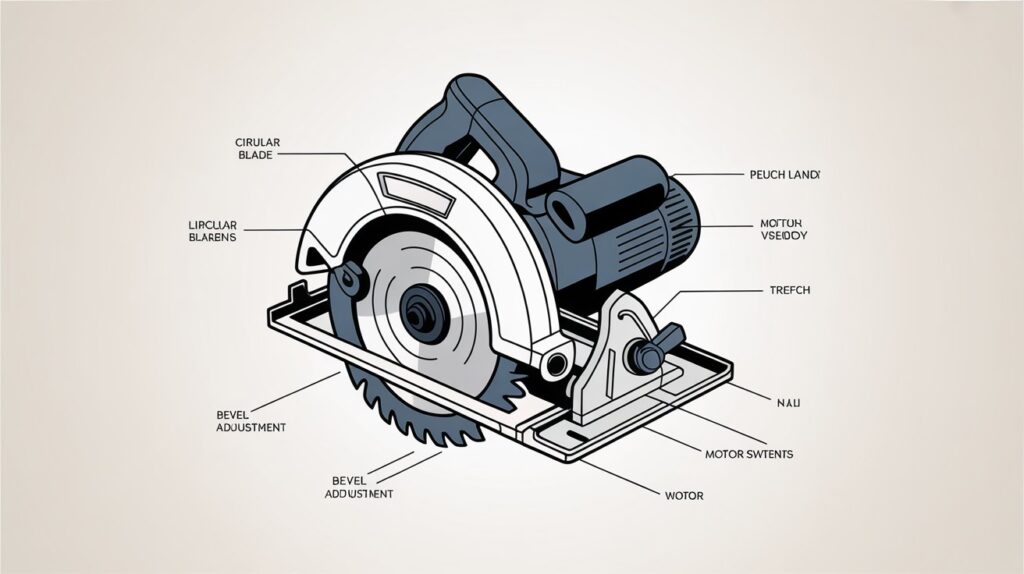
Table of Contents
Main Components of a Circular Saw
A circular saw is made up of several essential elements that work together to deliver accurate and efficient cutting performance. Understanding these circular saw components helps users identify how the tool functions and how each part contributes to overall operation.
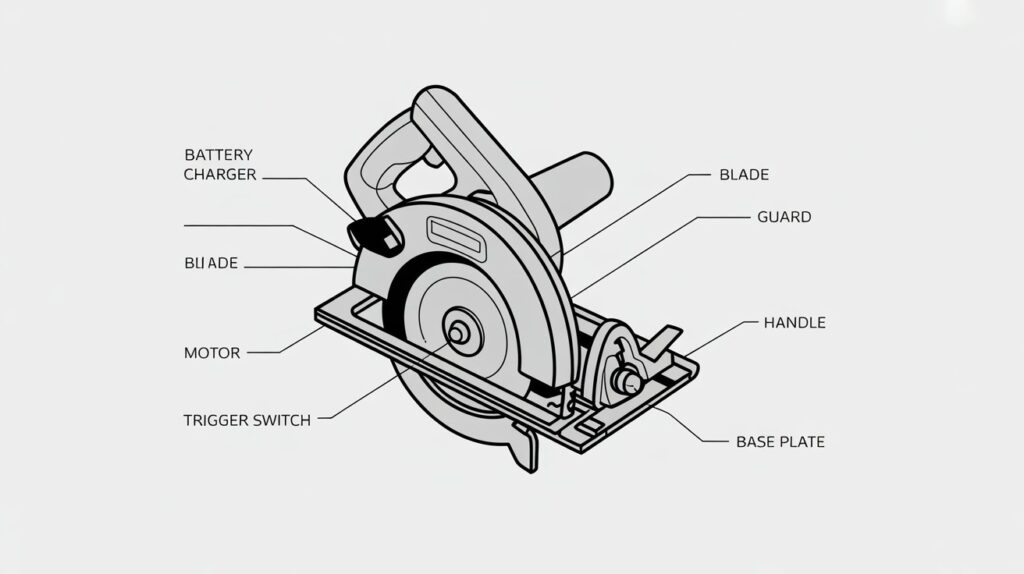
The most visible part is the blade, which is responsible for cutting different materials. Along with this, the motor provides the power needed to rotate the blade at high speed. These circular saw tool parts are supported by a strong housing that protects internal mechanisms and ensures durability during use.
Another important aspect is the tool’s structure, often explained as circular saw anatomy explained, which includes both external and internal elements. External parts like the base plate and handle allow control and stability, while internal elements ensure smooth operation. This combination forms the complete circular saw structure and design, allowing the tool to perform precise cuts.
In addition, safety features play a key role. Elements such as blade guards are considered circular saw safety components, designed to protect the user during operation. Altogether, these parts create a balanced system that improves efficiency, safety, and ease of use.
Circular Saw Components List
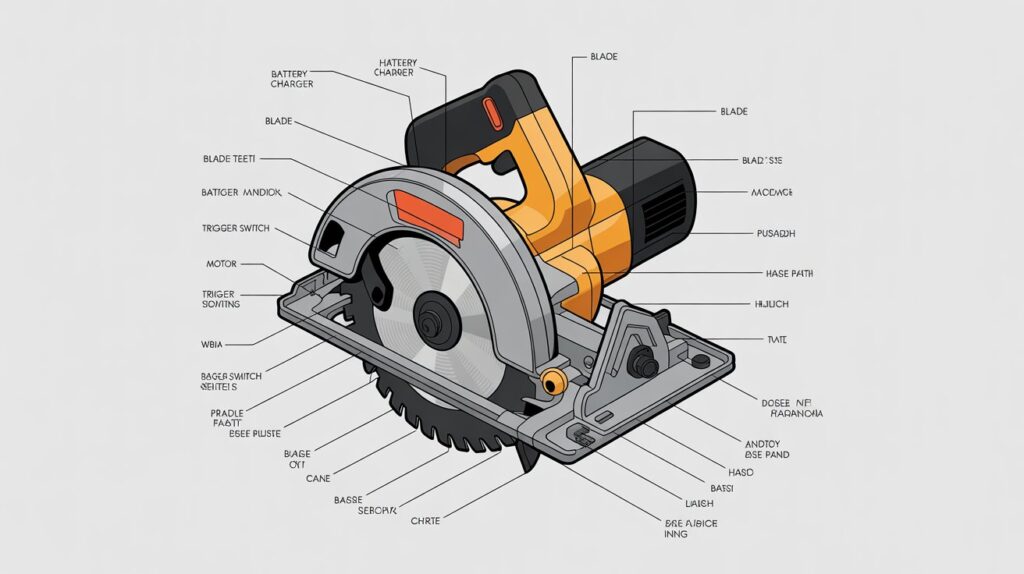
Battery Charger – Recharges the battery for cordless use.
Blade – The cutting disc that slices through materials.
Blade Teeth – Sharp edges on the blade that perform the actual cutting.
Blade Guard (Upper) – Fixed cover that protects the top part of the blade.
Blade Guard (Lower) – Movable guard that retracts during cutting.
Motor – Provides power to spin the blade.
Power Cord / Battery – Supplies electricity to the saw.
Handle (Main Handle) – Used to hold and control the saw.
Auxiliary Handle – Provides extra grip and stability.
Trigger Switch – Starts and stops the saw.
Safety Lock Button – Prevents accidental starting.
Base Plate (Shoe) – Flat surface that rests on the material for stability.
Bevel Adjustment Knob – Allows angled cuts.
Depth Adjustment Lever – Controls cutting depth.
Arbor – Shaft that holds the blade in place.
Spindle – Rotating shaft connected to the motor.
Spindle Lock – Locks the blade for easy removal or replacement.
Blade Bolt – Secures the blade onto the arbor.
Washer (Flange) – Keeps the blade stable during rotation.
Dust Port – Directs sawdust away from the cutting area.
Ventilation Slots – Allow airflow to cool the motor.
Housing (Casing) – Outer body that protects internal parts.
Gear System – Transfers power from motor to blade.
Carbon Brushes – Conduct electricity inside the motor.
Electric Switch Assembly – Controls power flow internally.
Guide Rail / Rip Fence – Helps make straight cuts.
Laser Guide (if available) – Shows cutting line for accuracy.
LED Light (if available) – Improves visibility while cutting.
Cord Protector – Prevents damage to the power cord.
Battery Pack (Cordless models) – Stores and supplies power.
Circular Saw Blade
The blade is the most critical cutting element in a circular saw, directly responsible for shaping and finishing the material. Understanding circular saw blade parts is essential for achieving clean and accurate results in different types of cutting tasks.
Blades come in a variety of designs depending on their purpose. The number and shape of teeth determine how smooth or fast a cut will be. For example, blades with more teeth produce finer cuts, while fewer teeth allow faster cutting. This relates closely to saw blade types and uses, where each blade is designed for specific materials such as wood, metal, or plastic.
The construction and layout of the blade are also part of the overall cutting tool components. Most blades are made from high-speed steel or carbide-tipped materials to ensure durability and long-lasting sharpness. The inner hole, known as the arbor hole, allows the blade to fit securely onto the saw.
To fully understand how a circular saw works, it is important to see how the blade interacts with the motor and other parts. The motor spins the blade at high speed, allowing the teeth to cut through materials with precision and efficiency.
Proper blade selection and maintenance are also important aspects of power tool maintenance tips. Keeping the blade sharp and clean not only improves cutting performance but also increases safety and extends the life of the tool.
Motor and Power System
The motor and power system are responsible for driving the entire cutting operation. These circular saw motor parts convert electrical energy into mechanical motion, allowing the blade to rotate at high speed for efficient cutting.
There are two primary types of power sources: corded and battery-powered. Corded models rely on a continuous electricity supply, while cordless versions use rechargeable batteries. This distinction is important when comparing cordless circular saw parts, as battery capacity and efficiency directly affect performance and runtime.
The motor works as part of the overall electric saw working mechanism, where energy flows through internal components to generate rotation. This process is supported by gears and internal systems that ensure smooth and consistent power delivery.
Understanding circular saw internal parts helps explain how the motor connects with other elements such as the spindle and blade. These internal systems are designed to maintain balance, reduce vibration, and improve cutting accuracy.
Proper care of the motor is also essential. Following basic power tool maintenance tips, such as keeping vents clean and avoiding overload, can help maintain performance and extend the lifespan of the tool.
Blade Guard System
The blade guard system is an essential safety feature designed to protect the user during cutting operations. It is considered one of the most important circular saw safety components, as it helps prevent accidental contact with the moving blade.
This system usually consists of two parts: a fixed upper guard and a retractable lower guard. The lower guard moves automatically as the saw cuts through material and returns to its original position once the cut is complete. This mechanism is part of the overall circular saw anatomy explained, showing how safety and functionality work together.
The guard system also plays a role in the circular saw structure and design, ensuring that protection does not interfere with cutting performance. It is carefully engineered to allow visibility while maintaining safety.
To ensure proper function, regular inspection is necessary. Following simple power tool maintenance tips, such as cleaning debris and checking for smooth movement, helps keep the guard working effectively and reduces the risk of accidents.
Base Plate (Shoe) and Adjustment Mechanisms
The base plate, also known as the shoe, provides a stable platform that rests on the material during cutting. It is one of the key circular saw base plate parts that ensures balance, control, and straight cuts.
This flat metal plate helps guide the tool smoothly across the surface, making it an important part of the overall circular saw tool parts system. A strong and properly aligned base plate improves cutting accuracy and reduces vibration during operation.
Adjustment mechanisms attached to the base plate allow users to control cutting depth and angle. These features are part of the broader functions of circular saw parts, enabling the saw to handle different types of cuts such as bevel and depth adjustments.
The design of the base plate also reflects the circular saw structure and design, where precision and stability are essential for effective performance. Proper alignment and regular checks are important, and following basic power tool maintenance tips can help maintain accuracy and extend the life of the tool.
Handle and Trigger Switch
The handle and trigger switch are essential for controlling the tool during operation. These parts are designed to provide comfort, stability, and precise handling, making them important circular saw components for safe and effective use.
The main handle allows the user to grip the tool firmly, while an additional front handle offers better balance and control. This design is part of the overall circular saw anatomy explained, where user interaction plays a key role in performance and safety.
The trigger switch controls the power flow to the motor. When pressed, it activates the cutting action, and when released, it stops the blade. This mechanism is a vital part of the electric saw working mechanism, ensuring smooth and responsive operation.
Many saws also include a safety lock feature near the trigger to prevent accidental starts. These features are considered circular saw safety components, helping reduce risks during use.
Understanding how these controls function is important for both beginners and experienced users, as they directly affect handling, accuracy, and overall efficiency.
Spindle, Arbor, and Locking Mechanism
The spindle, arbor, and locking mechanism are essential parts that hold and control the blade during operation. These elements are part of the circular saw internal parts, ensuring the blade stays secure and rotates properly.
The spindle is the rotating shaft connected to the motor, while the arbor is the section where the blade is mounted. Together, they form a critical part of the cutting tool components, allowing the blade to spin at high speed with stability and precision.
The locking mechanism, often called the spindle lock, is used when changing the blade. It prevents the spindle from rotating, making it easier and safer to remove or install the blade. This feature is an important detail in circular saw anatomy explained, helping users understand how different parts work together.
These components also play a role in how a circular saw works, as they directly transfer power from the motor to the blade. Proper tightening and regular inspection are important, and following basic power tool maintenance tips helps ensure safe operation and long-term performance.
Dust Port and Ventilation System
The dust port and ventilation system help maintain a clean and efficient working environment during cutting. These features are important circular saw components that improve visibility and protect the internal mechanisms of the tool.
The dust port is designed to direct sawdust away from the cutting area. In some models, it can be connected to a vacuum system for better dust collection. This function supports the overall functions of circular saw parts, making cutting more accurate by keeping the line of sight clear.
Ventilation slots allow air to flow through the tool, preventing overheating. This airflow is a key part of the electric saw working mechanism, as it helps regulate the temperature of the motor and internal systems during operation.
These features are also included in the circular saw structure and design, ensuring that performance and durability are not affected by dust buildup or excessive heat. Regular cleaning and inspection, following basic power tool maintenance tips, can help keep these systems working properly and extend the life of the tool.
Maintenance and Care of Circular Saw Parts
Proper maintenance is essential to keep the tool working efficiently and safely over time. Understanding circular saw replacement parts and when to change them helps prevent performance issues and ensures consistent cutting results.
Regular cleaning is one of the most important steps. Dust and debris can affect performance, so keeping the tool clean supports the overall functions of circular saw parts and improves accuracy. Special attention should be given to the blade, guards, and ventilation areas.
Inspection is also necessary to identify worn or damaged components. Checking key circular saw internal parts such as the motor, spindle, and switches helps detect problems early before they become serious.
Another important aspect is lubrication and proper storage. These practices are part of essential power tool maintenance tips, helping reduce wear and extend the life of the tool.
By following simple care routines, users can maintain performance, improve safety, and ensure long-term reliability of their cutting equipment.
Top 5 FAQs about cicular saw parts
Q.1 What are the main circular saw parts and their functions?
The main components include the blade, motor, base plate, handle, and blade guard. Each part plays a crucial role in cutting accuracy, safety, and overall performance.
Q.2 How do I maintain circular saw parts for long-term use?
Regular cleaning, blade sharpening, checking the motor, and inspecting guards and adjustment mechanisms keep your saw efficient, safe, and durable.
Q.3 Can I replace individual circular saw parts?
Yes, many components such as blades, guards, and bearings can be replaced. Using the correct circular saw replacement parts ensures safe operation and consistent performance.
Q.4 What safety features are included in circular saw parts?
Blade guards, trigger locks, and ergonomic handles are essential circular saw safety components that prevent accidents and improve control during cutting.
Q.5 How do I choose the right circular saw blade for my project?
Consider material type, blade teeth count, and cutting speed. Different saw blade types and uses ensure clean cuts for wood, metal, or plastic.