
Introduction
A Coping Saw Blade plays an important role in woodworking projects that require curved cuts, detailed patterns, and precise shaping. Choosing the correct blade can make cutting easier and help produce cleaner results. However, blade size, tooth count, material, and installation all affect cutting performance. This guide explains the different blade types, common sizes, materials, cutting techniques, replacement methods, and maintenance practices to help woodworkers make informed decisions.

Table of Contents
What Is a Coping Saw Blade and How Does It Work?
A coping saw uses a thin, narrow blade to cut curves, irregular shapes, and detailed patterns in wood. Unlike wider saw blades, its narrow design allows users to change cutting direction without removing much material. This makes it useful for woodworking tasks that require control around curved edges and small details.
How the Blade Cuts Through Wood
The blade contains small, sharp teeth along one edge. When the user moves the saw forward and backward, these teeth gradually remove small pieces of wood to create a cut. The blade tooth count affects how quickly and smoothly the material is cut. A blade with more teeth per inch generally produces a finer cut, while fewer teeth can remove material faster.
Understanding Its Structure and Movement
The blade is attached between two ends of a C-shaped frame and held under tension. Proper blade tension keeps it straight during cutting and helps prevent unwanted bending. Most models allow the blade to rotate inside the frame, making it easier to follow different cutting angles.
A suitable wood cutting blade can handle straight sections, curved lines, and internal openings. For detailed work, a fine-tooth saw blade provides better control and a smoother finish. However, cutting speed should remain steady to avoid damaging the blade.
Where This Cutting Design Is Useful
This tool is commonly used for decorative woodwork, furniture joints, wooden patterns, and small craft projects. Its ability to follow tight curves makes it useful when a regular hand saw cannot reach or control the required shape. Proper handling also improves cutting accuracy and reduces rough edges.
Different Types of Coping Saw Blades
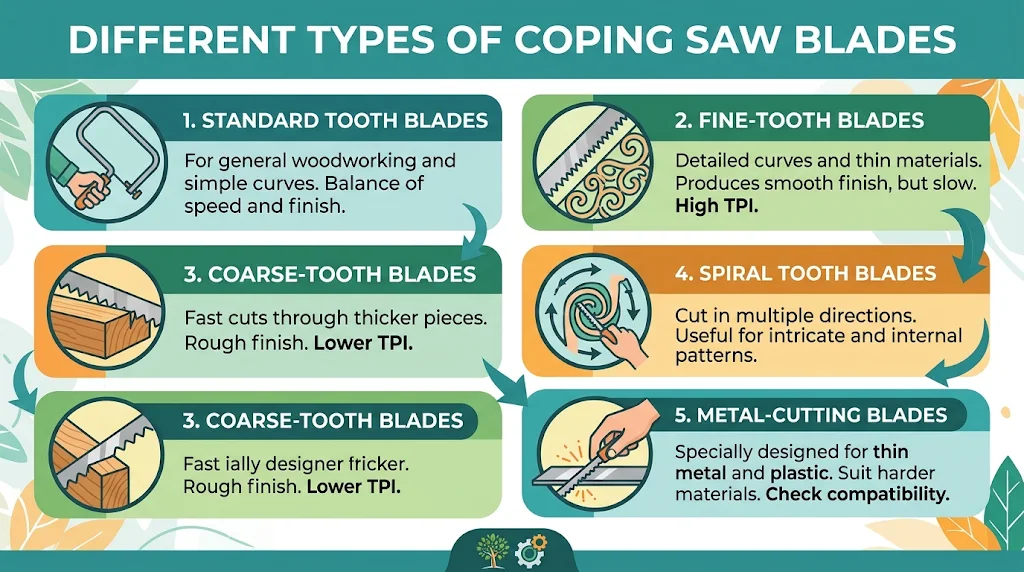
Not all coping saw blades are designed for the same cutting tasks. They differ in tooth arrangement, thickness, material, and cutting performance. Choosing the correct type depends on the wood’s thickness, the shape being cut, and the finish required. Understanding these differences helps woodworkers avoid rough edges, broken teeth, and unnecessary cutting effort.
Standard Tooth Blades
Standard tooth blades have evenly spaced teeth and are commonly used for general woodworking. They are suitable for cutting softwood, thin wooden boards, and simple curved patterns. Their balanced tooth arrangement makes them a practical choice for everyday cutting tasks.
Fine-Tooth Blades
Fine-tooth saw blades have more teeth per inch (TPI), allowing them to remove smaller amounts of material with each stroke. They are useful for thin wood, delicate patterns, and detailed curves where a smoother finish is important. However, they usually cut more slowly than coarse-tooth blades.
Coarse-Tooth Blades
These blades have fewer, larger teeth that remove material more quickly. They work well on thicker wooden pieces where a fast cut is more important than a very smooth edge. Excessive pressure should be avoided because it can damage the teeth or bend the blade.
Spiral Tooth Blades
Unlike ordinary blades, spiral blades have teeth arranged around their circumference. This design allows cutting in different directions without repeatedly rotating the saw frame. They are useful for intricate shapes and internal patterns, although they can leave wider or rougher cuts.
Metal-Cutting Blades
Some coping saw frames accept specially designed blades for cutting thin metal, plastic, or similar materials. These blades have tooth designs suited to harder materials. Always check the manufacturer’s compatibility instructions before fitting one.
Choosing Between Different Blade Designs
Consider these factors before selecting a blade:
- Blade tooth count: Higher TPI generally produces finer cuts.
- Blade material: Hardened steel and other blade materials offer different levels of durability.
- Blade thickness: Thinner blades can follow tighter curves but may be more delicate.
- Cutting accuracy: Match the blade design to the required shape and finish.
- Blade tension: Correct tension helps maintain control and reduces unwanted bending.
The right selection depends on the material and the level of detail required, rather than choosing a blade based only on its tooth count.
Common Coping Saw Blade Sizes and Tooth Counts
Selecting the correct blade size is important for achieving clean cuts and maintaining control during woodworking. Blades are available in different lengths, thicknesses, and tooth counts to handle various materials and cutting patterns. Using an unsuitable size can make the saw difficult to control or increase the chance of blade breakage.
Standard Blade Lengths and Dimensions
Most traditional coping saws use blades approximately 6 to 6.5 inches (150–165 mm) long, although the correct length depends on the frame design. Always check the manufacturer’s specifications before purchasing a replacement.
Other important measurements include:
- Blade thickness: Thin blades can follow tighter curves, while thicker blades offer greater stability.
- Blade width: Narrow blades are generally better for intricate patterns and small openings.
- Blade length: The replacement must fit securely between the frame’s two mounting points.
Understanding Teeth Per Inch (TPI)
Blade tooth count is measured in teeth per inch (TPI). It indicates how many teeth are present along one inch of the cutting edge. Different tooth counts affect cutting speed, surface finish, and material removal.
| Tooth Count | Common Application |
|---|---|
| 10–15 TPI | Faster cutting in suitable thicker wood |
| 15–20 TPI | General woodworking |
| 20–24 TPI | Finer cuts and thinner materials |
| 24–32 TPI | Detailed work and delicate materials |
These ranges are general guidelines rather than fixed standards. Actual performance also depends on tooth shape, blade design, and material thickness.
How to Choose the Correct Size
For detailed patterns, a narrow fine-tooth saw blade can provide better control around tight curves. For thicker wood, a suitable coarser blade may remove material more efficiently.
Consider the following points before choosing:
- Match the blade length to your saw frame.
- Select TPI according to the material thickness.
- Choose a narrow blade for tight curves.
- Check blade tension after installation.
- Consider cutting accuracy and the required surface finish.
A suitable wood cutting blade should move smoothly through the material without excessive force. If the teeth become clogged or the blade bends repeatedly, check whether the selected size and tooth arrangement are appropriate for the task.
How to Choose the Right Blade for Woodworking Projects
Choosing a suitable blade depends on the type of wood, its thickness, and the shape you want to cut. A blade designed for detailed curves may not perform well when cutting thick wooden pieces. Before starting a project, consider the material and the level of accuracy required.
Match the Teeth to the Wood Thickness
The number of teeth per inch (TPI) affects how the blade cuts. A higher blade tooth count generally produces a finer cut, while a lower count removes material more quickly.
- Thin plywood: Choose a fine-tooth blade to reduce rough edges and splintering.
- Softwood: A medium-tooth blade is suitable for many general cutting tasks.
- Thick hardwood: Select a suitable coarser blade that can clear sawdust efficiently.
Avoid forcing the blade through hardwood because excessive pressure can cause bending or breakage.
Consider the Shape of Your Project
The cutting pattern also influences blade selection. Narrow blades are useful for tight curves, small openings, and decorative patterns. Wider blades provide more stability when making broader curves.
A suitable wood cutting blade should allow smooth movement without requiring excessive pressure. For delicate designs, a fine-tooth saw blade can improve the finish and help maintain cutting accuracy.
Check Blade Material and Compatibility
Different blades are manufactured from materials such as carbon steel and hardened steel. Their strength and flexibility can vary depending on the manufacturing process.
Before purchasing, check:
- Coping saw blade sizes to ensure the blade fits your frame.
- Coping saw blade material for the type of work you perform.
- Tooth direction and arrangement for the intended cutting method.
- Whether the frame supports the selected replacement blade.
Test the Blade Before Starting Detailed Work
Fit the blade securely and check its blade tension. Make a test cut on a spare piece of similar wood. Observe whether the teeth cut smoothly or leave excessive splinters. This simple test helps identify an unsuitable blade before you begin the actual project.
Coping Saw Blade Materials and Their Uses
The material used to manufacture a saw blade affects its hardness, flexibility, durability, and cutting performance. Different materials are suitable for different woodworking conditions. Understanding these differences helps users select a blade that can handle the required work without wearing out too quickly.
Carbon Steel Blades
Carbon steel blades are commonly used for general woodworking. They are suitable for cutting softwood, plywood, and other relatively soft materials. These blades are generally flexible, which helps when following curved patterns.
However, they can lose sharpness with regular use and may develop rust if stored in damp conditions. Cleaning and drying them after use helps extend their working life.
High-Carbon Steel Blades
High-carbon steel contains more carbon than ordinary carbon steel. This can increase hardness and help the teeth retain their sharpness. These blades are useful for detailed woodworking where consistent cutting performance is important.
Their hardness can also make them less tolerant of excessive bending. Avoid applying unnecessary pressure during cutting.
Hardened Steel Blades
Some blades receive heat treatment to improve their hardness and wear resistance. This helps the teeth withstand repeated contact with wood. Their performance depends on the manufacturing process and overall blade design.
Stainless Steel Blades
Stainless steel offers better resistance to corrosion than ordinary carbon steel. It can be useful in environments where moisture is a concern. However, not every stainless steel blade is designed for woodworking, so check its intended application before purchasing.
How to Select the Suitable Material
Consider these factors when comparing coping saw blade material options:
- Durability: Choose a blade suitable for the frequency and type of work.
- Flexibility: A flexible blade can follow curved patterns more easily.
- Blade tooth count: Match the teeth to the thickness and type of wood.
- Blade maintenance: Keep the blade clean and dry to reduce corrosion.
- Cutting accuracy: Select a suitable design for detailed or general cutting.
The correct material depends on the project, not simply on which blade is hardest. A properly selected blade with suitable blade tension can provide better control and reduce unnecessary wear.
Understanding Blade Teeth and Cutting Direction
The arrangement of teeth on a saw blade determines how it removes material, how smoothly it cuts, and how much effort is needed during operation. Understanding tooth shape, spacing, and direction helps woodworkers achieve cleaner results and avoid unnecessary blade damage.
How Blade Teeth Affect Cutting Performance
The small pointed edges along the blade are responsible for cutting through wood. Their spacing and shape influence the amount of material removed with each stroke.
Blade tooth count is measured in teeth per inch (TPI). A higher TPI generally produces a finer cut because the teeth remove smaller amounts of material. A lower TPI allows faster material removal but may leave a rougher surface.
- Fine teeth: Suitable for thin wood and detailed patterns.
- Medium teeth: Useful for general woodworking.
- Coarse teeth: Better suited to faster cutting in appropriate thicker materials.
The correct wood cutting blade should match the material thickness to prevent clogging, rough edges, and unnecessary cutting pressure.
Understanding Tooth Direction
Most traditional coping saw blades have teeth that point towards the handle. This means they cut on the pull stroke when the user draws the handle towards themselves.
However, some blades can be installed in the opposite direction, depending on the cutting requirement and manufacturer’s instructions.
Why Blade Direction Matters
Correct installation helps the saw cut efficiently and remain under proper tension. An incorrectly fitted blade may feel difficult to control or fail to cut smoothly.
Before starting work:
- Check which way the teeth are pointing.
- Confirm the blade is securely attached at both ends.
- Maintain suitable blade tension.
- Test the cutting action on a spare piece of wood.
Rotating the Blade for Different Cutting Angles
Many coping saw frames allow the blade to rotate within the frame. This feature helps users follow curved patterns and work around internal openings without changing the direction of the handle.
Keeping the blade properly aligned improves cutting accuracy and makes detailed woodworking easier. Avoid twisting or forcing it sideways, as excessive pressure can bend or break the thin metal strip.
How to Install and Replace a Coping Saw Blade
Correct installation is important for safe and controlled woodworking. A poorly fitted blade may become loose, bend during cutting, or break under pressure. Replacing a damaged or blunt blade also helps maintain smooth cutting performance.
When Should You Replace the Blade?
Check the blade before each project. Replacement may be necessary when:
- The teeth become dull or damaged.
- The blade bends and no longer stays straight.
- Cutting requires unusual force.
- The blade repeatedly slips from its holders.
- You notice cracks or broken teeth.
Steps for Installing a New Blade
Follow these steps to fit a replacement correctly:
1. Release the Old Blade
Hold the frame firmly and reduce its tension using the frame’s release mechanism or by carefully compressing it according to the manufacturer’s instructions.
2. Remove the Damaged Blade
Detach both ends from their holders. Handle the old blade carefully because broken teeth can be sharp.
3. Check the Replacement Size
Select a compatible blade that matches the frame’s required length and mounting design. Check the coping saw blade sizes before installation.
4. Position the New Blade
Attach one end to its holder, then connect the other end. Make sure the teeth point towards the handle for the usual pull-stroke cutting action.
5. Apply Proper Tension
Release the frame carefully or tighten its adjustment mechanism. Correct blade tension keeps the blade straight and helps prevent unwanted movement.
Checking the Installation
Before cutting wood, inspect both mounting points and make sure the blade is secure. Gently check its alignment without touching the sharp teeth.
A correctly installed blade should remain straight without excessive looseness. Proper blade installation also supports better cutting accuracy and reduces the risk of unexpected breakage.
Safety Precautions During Replacement
Wear safety glasses and keep your fingers away from the teeth. Never force a damaged blade into its holders. If the frame or mounting pins are worn, repair or replace the faulty components before using the saw again.
How to Use a Coping Saw Blade for Curved and Detailed Cuts
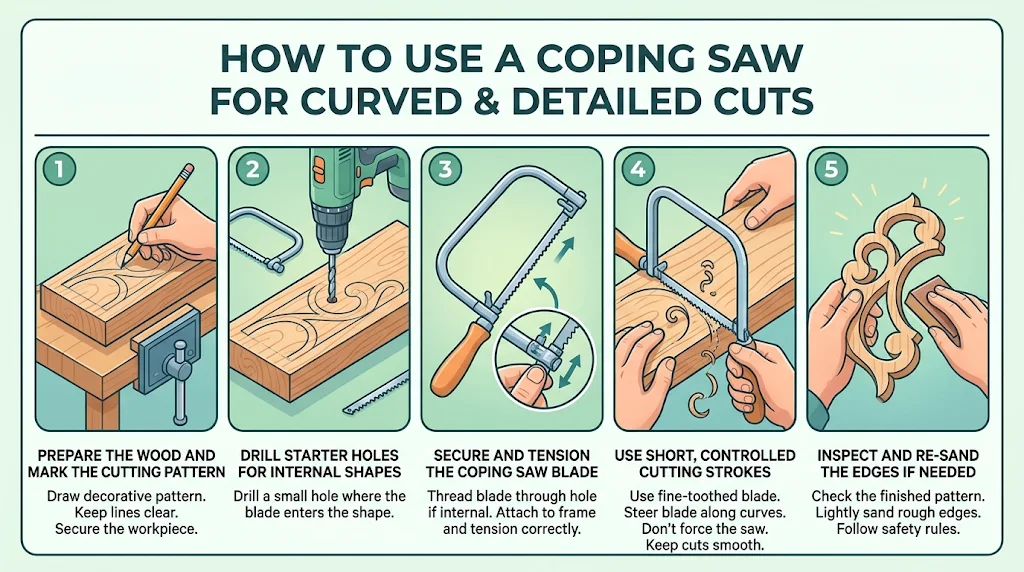
Cutting curved lines and decorative patterns requires patience, steady hand movement, and proper blade control. A coping saw is particularly useful for these tasks because its narrow blade can follow changing directions without removing large amounts of wood. The right technique helps produce cleaner edges and reduces the chance of breaking the blade.
Prepare the Wood and Mark the Cutting Pattern
Start by selecting a suitable piece of wood and drawing the required shape with a pencil. Make the cutting line clearly visible, especially around tight curves and small corners.
Secure the workpiece with a clamp or bench vice so it cannot move during cutting. For internal shapes, drill a small starter hole where the blade needs to enter.
Use Short, Controlled Cutting Strokes
Hold the handle comfortably and keep the blade aligned with the marked line. Begin with gentle strokes to create a small guiding cut before continuing through the material.
Follow these practices:
- Move the saw steadily without applying excessive pressure.
- Keep the workpiece securely supported.
- Turn the saw gradually when following curved lines.
- Use shorter strokes around narrow corners.
- Allow the teeth to remove material naturally.
A suitable wood cutting blade with an appropriate blade tooth count makes it easier to control the cut.
Follow Tight Curves Without Twisting the Blade
For intricate patterns, slightly rotate the frame or workpiece as needed. Many frames allow the blade to turn in its holders, helping maintain a comfortable handle position.
Avoid forcing the blade sideways. Excessive twisting can bend the metal strip, damage its teeth, or cause it to break. Maintaining proper blade tension also helps the blade stay stable during cutting.
Improve the Finish After Cutting
Once the shape is complete, remove the workpiece and inspect the edges. Small rough areas can be smoothed using suitable sandpaper or a fine file.
For delicate woodworking, a fine-tooth saw blade can help produce smoother edges and improve cutting accuracy. Clean away sawdust before inspecting the finished pattern.
Cleaning, Maintaining, and Storing Coping Saw Blades
Regular cleaning and proper storage help keep saw blades in good working condition. Wood dust, moisture, and resin can collect around the teeth during cutting, affecting performance over time. A simple maintenance routine helps reduce corrosion, prevent unnecessary wear, and keep the blade ready for future woodworking projects.
Remove Sawdust and Wood Residue After Use
After completing a project, remove loose sawdust using a soft brush. If sticky resin or wood residue remains, use a suitable cleaning product according to its instructions.
Avoid rubbing your fingers directly along the sharp teeth. A soft cloth or small brush provides safer handling.
Keep the Blade Dry to Prevent Rust
Moisture can cause corrosion, particularly on carbon steel blades. After cleaning, wipe the metal surface with a dry cloth and allow it to dry completely.
For longer storage, apply a very thin layer of suitable rust-prevention oil if recommended by the manufacturer. Keep oily blades away from wooden surfaces before use.
Inspect Teeth and Mounting Points
Regular inspection helps identify damage before the next project.
Check the following:
- Blade tooth count: Look for missing, worn, or damaged teeth.
- Blade tension: Check that the blade remains properly secured.
- Blade material: Look for rust, cracks, or permanent bending.
- Blade installation: Inspect both mounting points for wear.
Replace damaged blades instead of continuing to use them. A worn blade can produce rough cuts and require unnecessary force.
Store Blades in a Dry and Protected Place
Proper storage prevents accidental damage and corrosion.
- Keep unused blades in their original packaging.
- Store them in a dry toolbox or covered container.
- Separate different coping saw blade sizes to make selection easier.
- Avoid placing heavy tools on top of loose blades.
- Keep blades away from damp floors and leaking areas.
When to Replace Rather Than Maintain
Cleaning cannot restore missing teeth, repair cracks, or correct permanent bending. When a blade becomes damaged or noticeably dull, replace it with a compatible option. Regular blade maintenance and careful handling help improve reliability and support consistent woodworking results.
Conclusion
Choosing the right blade makes a noticeable difference in woodworking accuracy and cutting quality. Understanding tooth counts, blade materials, sizes, and cutting directions helps users select suitable options for different projects. Proper installation, controlled cutting techniques, and regular maintenance also reduce unnecessary wear and blade damage. By following these practical guidelines, woodworkers can achieve cleaner cuts, handle detailed patterns more confidently, and keep their tools in good working condition.
Top 5 Frequently Asked Questions (FAQs)
Q1. What is a coping saw blade used for?
A coping saw blade is used for cutting curves, intricate shapes, decorative patterns, and small openings in wood.
Q2. How many teeth per inch should a coping saw blade have?
The suitable TPI depends on the material. Higher TPI generally provides smoother cuts, while lower TPI removes wood faster.
Q3. How do I choose the right coping saw blade?
Consider the wood thickness, required cutting shape, tooth count, blade length, and compatibility with your saw frame.
Q4. Which direction should coping saw blade teeth face?
For normal pull-stroke cutting, the teeth should point towards the handle so they cut when you pull the saw.
Q5. When should I replace a coping saw blade?
Replace it when the teeth become dull or damaged, the blade bends permanently, or it repeatedly breaks during normal cutting.