
Introduction
Scroll saw blades play an important role in creating accurate cuts, smooth edges, and detailed woodworking designs. Choosing the right blade can make cutting easier and help reduce rough edges and broken blades.
Different blade types and sizes suit different materials and projects. Understanding tooth patterns, teeth per inch (TPI), and wood thickness helps you select the right option for your needs. This guide explains the main blade types, how to choose the correct size, and how to install, maintain, and use blades safely.
Table of Contents
What Are Scroll Saw Blades?
Scroll saw blades are thin, narrow cutting tools used with a scroll saw to create detailed shapes and curved cuts in wood. They help woodworkers cut small designs, letters, decorative patterns, and craft shapes with good control.
These blades move up and down quickly, allowing users to guide wood through detailed cuts. The right blade depends on the wood’s thickness, the design’s complexity, and the finish you want.
Different blade types are made for different tasks. Some work well for tight curves and fine details, while others are better for thicker materials or faster cutting. Choosing a suitable blade helps improve accuracy, reduce rough edges, and make woodworking easier.
10 Different Types of Scroll Saw Blades
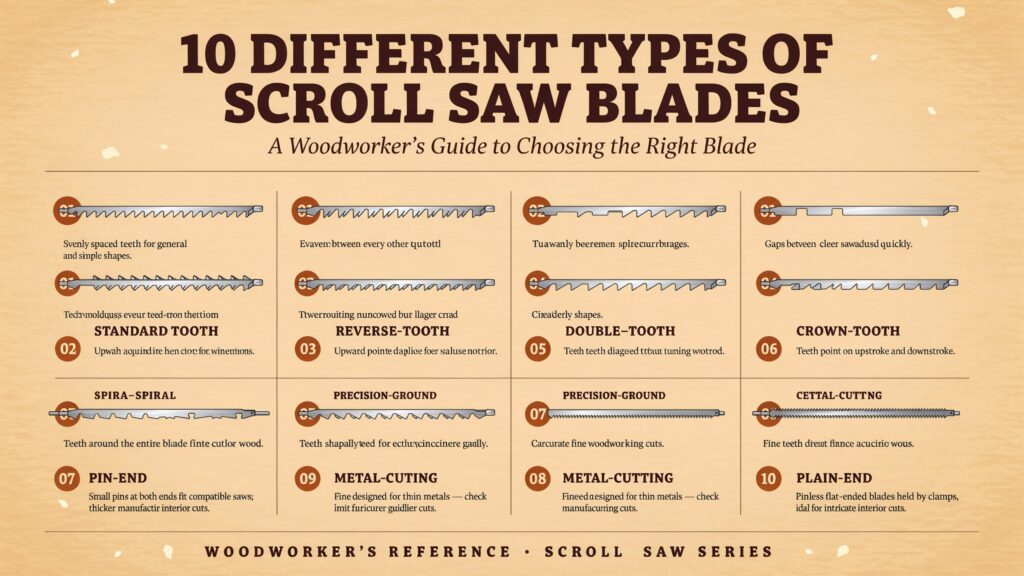
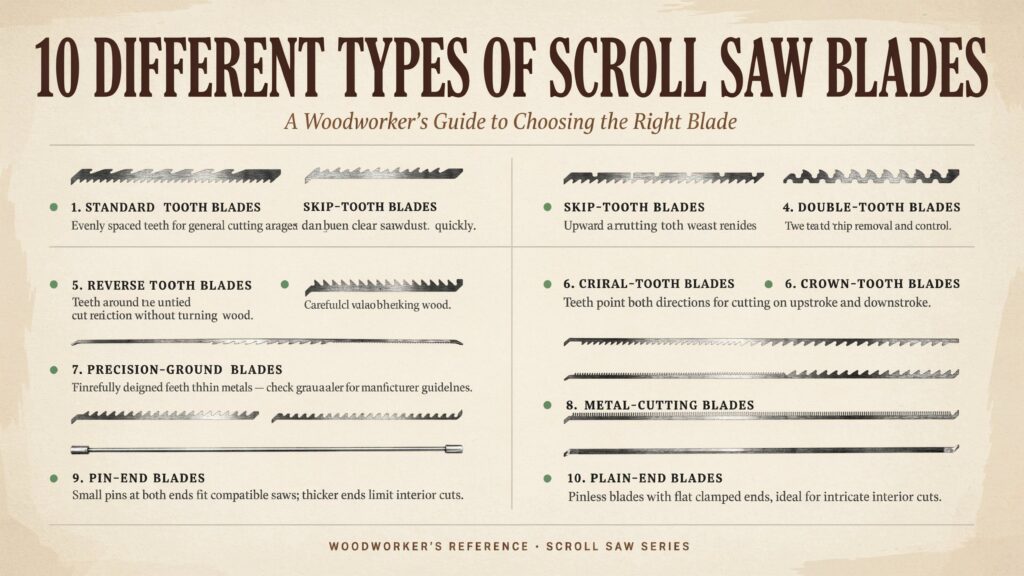
Different blade designs help woodworkers make straight cuts, tight curves, and detailed patterns. Choosing the right type depends on the material, its thickness, and the finish you want.
1. Standard Tooth Blades
These have evenly spaced teeth and work well for general cutting. They are useful for simple shapes and everyday woodworking.
2. Skip-Tooth Blades
These have a gap between every other tooth. They clear sawdust quickly and help keep the blade cooler during cutting.
3. Reverse-Tooth Blades
Some teeth point upward near the bottom. This design helps reduce splintering on the underside of wood.
4. Double-Tooth Blades
These have two teeth followed by a larger gap. They provide good cutting control and help remove wood chips.
5. Spiral Scroll Saw Blades
These have teeth around the entire blade. They can cut in different directions without turning the wood, but often leave rough edges.
6. Crown-Tooth Blades
Their teeth point in both directions, allowing cutting on the upstroke and downstroke. They can help produce clean edges on suitable materials.
7. Precision-Ground Blades
These have carefully shaped teeth for accurate cutting. They are useful for fine woodworking cuts and detailed designs.
8. Metal-Cutting Blades
These have fine teeth designed for suitable thin metals. Always check the blade and saw manufacturer’s material guidelines before use.
9. Pin-End Blades
These have small pins at both ends and fit compatible saws. Their thicker ends may limit very small interior cuts.
10. Plain-End Blades
Also called pinless scroll saw blades, these have flat ends held by clamps. They are useful for intricate designs and interior cuts that require threading the blade through a drilled hole.
Explore our guide to 10 Creative Woodworking Patterns and Cutting Tips for inspiration and practical tips to improve your scroll saw skills. Scroll Saw Projects: 30 Creative Ideas for Woodworking
How to Choose the Right Type
Consider scroll saw blade selection, wood thickness, and the required finish before starting. For cutting intricate wood patterns, choose a blade that can handle tight curves and fine details. Always check your saw’s compatibility and practise on scrap wood first.
Understanding Blade Sizes and TPI
The blade’s dimensions and tooth count per inch influence how quickly it cuts, how precise the cut is, and how smooth the edge looks.TPI means the number of teeth found in one inch of a blade. Understanding these details helps you choose the right blade for your woodworking project.
Blade Sizes
Smaller blades are usually better for tight curves and delicate designs. Larger blades are generally more suitable for thicker wood and stronger cuts. The best size depends on the wood thickness, design details, and the saw’s compatibility.
Understanding TPI
A higher TPI means more teeth per inch, which often gives a smoother cut but removes material more slowly. A lower TPI usually cuts faster and clears sawdust more easily, making it useful for thicker wood.
- High TPI: Suitable for thin wood and fine details.
- Medium TPI: Useful for general woodworking and curved cuts.
- Low TPI: Often better for thicker wood and faster cutting.
How to Choose the Right Blade for Wood
Choosing the right blade depends on wood thickness, hardness, and the design you want to cut. Proper scroll saw blade selection helps improve accuracy and produce clean edges.
1. Consider Wood Thickness
For thin wood, choose a smaller blade with more teeth. For thick wood, a larger blade with fewer teeth can help remove sawdust and reduce blade strain. Choose scroll saw blades for thick wood according to the manufacturer’s guide.
2. Check the Wood Type
Softwood is generally easier to cut than dense hardwood. Harder wood may need a stronger blade to prevent bending or breaking. Always test the blade on a scrap piece first.
3. Match the Blade to Your Design
For tight curves and cutting intricate wood patterns, use a narrow blade. For simple shapes and straight cuts, a larger blade may provide better control.
4. Choose the Right Teeth Per Inch
A higher TPI often gives a smoother finish on thin wood, while a lower TPI can cut thicker wood faster. The best choice depends on the blade design and material.
5. Check Blade Compatibility
Before buying, check whether your saw needs plain-end or pin-end blades. Correct fitting and tension help improve cutting performance and safety.
Plain-End vs. Pin-End Blades
Scroll saw blades come in plain-end and pin-end styles, each designed for different mounting systems and cutting needs.
Plain-End Blades
Plain-end blades have smooth ends secured by clamps. They are ideal for detailed designs because they can pass through a small drilled hole to make internal cuts.
These blades are useful for cutting letters, decorative shapes, and complex patterns. However, the clamps must hold the blade securely, and the user needs to adjust the tension correctly.
Pin-End Blades
Pin-end blades have tiny pins on both ends that fit into matching saw holders, allowing quick and easy installation.
However, the pins make these blades less suitable for very small interior openings because they may not fit through narrow drilled holes. Always check the saw’s manual before selecting this type.
Which Type Should You Choose?
Choose a blade that matches your machine and project. Plain-end blades are often suitable for intricate interior cuts, while pin-end blades can be convenient for compatible saws and general cutting tasks.
How to Install and Tension a Blade
Correct blade installation is important for accurate cuts and safe operation. A blade that is loose, incorrectly positioned, or too tightly tensioned may break or produce poor results.
Step 1: Disconnect the Power
Switch off the saw and unplug it before changing the blade. This prevents accidental starting while you work.
Step 2: Release the Blade Tension
Follow the manufacturer’s instructions to loosen the tension mechanism. Remove the old blade carefully, especially if it is broken or damaged.
Step 3: Insert the New Blade
Secure the blade in both holders. For internal cuts, thread a compatible plain-end blade through the pre-drilled hole before tightening it.
Step 4: Check the Tooth Direction
Most scroll saw cuts are made with the teeth pointing downward, but always follow your machine’s instructions and the blade manufacturer’s guidance. Incorrect positioning can affect cutting performance.
Step 5: Adjust the Blade Tension
Use the saw’s tension mechanism to make the blade firm and stable. Correct blade tension adjustment helps the blade follow the intended cutting line and reduces unwanted movement.
Do not overtighten the blade, as excessive tension can cause it to break.
Step 6: Test the Installation
Check that both ends are securely held. After reconnecting the power, make a short test cut in scrap wood while keeping your hands clear of the moving blade.
Common Blade Problems and Solutions
Several issues can affect cutting accuracy, wood quality, and blade life. Understanding their causes can help you solve them before they affect your project.
Blade Breakage
Blades may break because of excessive tension, worn teeth, incorrect installation, or too much pressure on the wood.
Solution: Check the blade condition, follow the manufacturer’s tension instructions, and guide the wood gently. Avoid forcing it through the blade.
Rough Cutting Edges
Rough edges may occur when the blade is unsuitable for the wood or when its teeth are dull. Incorrect feed speed can also affect the finish.
Solution: Select an appropriate blade size and tooth pattern. Test the blade on scrap wood and adjust your cutting speed.
Burning on the Wood
Burn marks can appear when the blade creates too much friction. A dull blade, excessive pressure, or unsuitable cutting speed may contribute to the problem.
Solution: Inspect the blade, reduce unnecessary pressure, and maintain a steady feed rate. Make sure the blade is suitable for the material.
Blade Wandering
A blade may move away from the intended line if it is damaged, incorrectly tensioned, or unsuitable for the cut.
Solution: Check the blade’s condition and tension. Guide the wood slowly without twisting or forcing it.
Wood Tear-Out
Tear-out occurs when wood fibres break away around the cut, leaving a rough surface. This is more noticeable on delicate or thin pieces.
Solution: Try suitable reverse-tooth scroll saw blades, which can help reduce splintering on the underside of the wood. Test the blade first because cutting results depend on the material and setup.
How to Maintain and Replace Blades
Regular maintenance helps preserve cutting quality and makes it easier to identify damaged blades before starting a project.
Clean Blades After Use
Clean off sawdust and leftover wood particles after every use. Keep the blade and surrounding machine parts clean according to the manufacturer’s instructions.
Store Blades Properly
Store unused blades in a dry container or organiser. Keep different sizes separate so they are easy to identify and less likely to become bent or damaged.
Inspect Blades Regularly
Inspect the blade before each job for bent areas, rust, worn teeth, or damage, as these can affect cutting quality or cause breakage.
Know When to Replace a Blade
Replace a blade if it becomes dull, damaged, or difficult to control. Signs of wear may include rough cuts, increased burning, or the need to apply more pressure than usual.
Install the Replacement Correctly
Unplug the saw before taking out the used blade. Install the replacement according to the machine’s instructions, secure both ends, and adjust the tension correctly.
Good care supports blade durability and performance and helps you achieve more consistent results.
Choosing Blades for Beginner Woodworking
Beginners should focus on learning basic cutting techniques before moving to complicated designs. A suitable blade makes it easier to control the wood and understand how different tooth patterns affect cutting quality.
Start with Simple Projects
Test your cutting technique on leftover wood before working on your final piece.. Begin with straight lines, gentle curves, and simple shapes. As your skills improve, move on to tighter curves and more detailed designs.
Match the Blade to the Wood
Thin wood and delicate designs usually need a finer blade, while thicker wood may require a larger blade with suitable tooth spacing. Consider the material’s hardness as well as its thickness.
Understand TPI
Teeth per inch (TPI) describes how many teeth are present in one inch of the blade. A higher TPI often produces a smoother cut but may remove material more slowly. A lower TPI can cut faster and clear larger chips, depending on the blade design.
Check Saw Compatibility
Before purchasing blades, check whether your machine accepts plain-end or pin-end types. Also confirm the blade size recommended by the manufacturer.
Improve Your Skills Gradually
Choose the best scroll saw blades for your specific material and project rather than assuming one blade works for every task. Practise on Scroll saw projects for beginners, use suitable safety equipment, and follow your machine’s operating instructions.
With practice, you will learn how blade size, tooth pattern, tension, and cutting speed affect the final result.
Conclusion
Choosing the right scroll saw blades depends on the wood thickness, blade size, tooth pattern, and type of cut you want to make. Understanding these factors helps improve accuracy, reduce rough edges, and create cleaner woodworking projects.
Always check blade compatibility, maintain proper tension, and replace damaged blades when needed. Beginners should practise on scrap wood before attempting detailed patterns. With the right blade and safe working habits, you can improve your cutting skills and achieve better results in your woodworking projects.
Top Five Frequently Asked Questions
Q1. Do all scroll saws use the same blades?
No, not all saws use the same blades. Some require plain-end blades, while others use pin-end blades. Consult the saw’s instruction guide to ensure you select a compatible blade.
Q2. Which blade is best for beginners?
A general-purpose blade is a good starting point for beginners. Choose the correct size for your wood and practise on scrap pieces.
Q3. What does TPI mean in a saw blade?
TPI means teeth per inch. Higher TPI often provides smoother cuts, while lower TPI can remove wood faster, depending on the material and blade design.
Q4. How often should I replace a scroll saw blade?
Replace a blade when it becomes dull, bent, damaged, or starts producing rough cuts. Replacement frequency depends on the material and how often you use it.
Q5. Why do scroll saw blades break frequently?
Blades may break because of incorrect tension, excessive cutting pressure, worn teeth, or improper installation.Inspect the blade and follow the guidelines provided by the saw’s manufacturer.